 Foundation Musick's Monument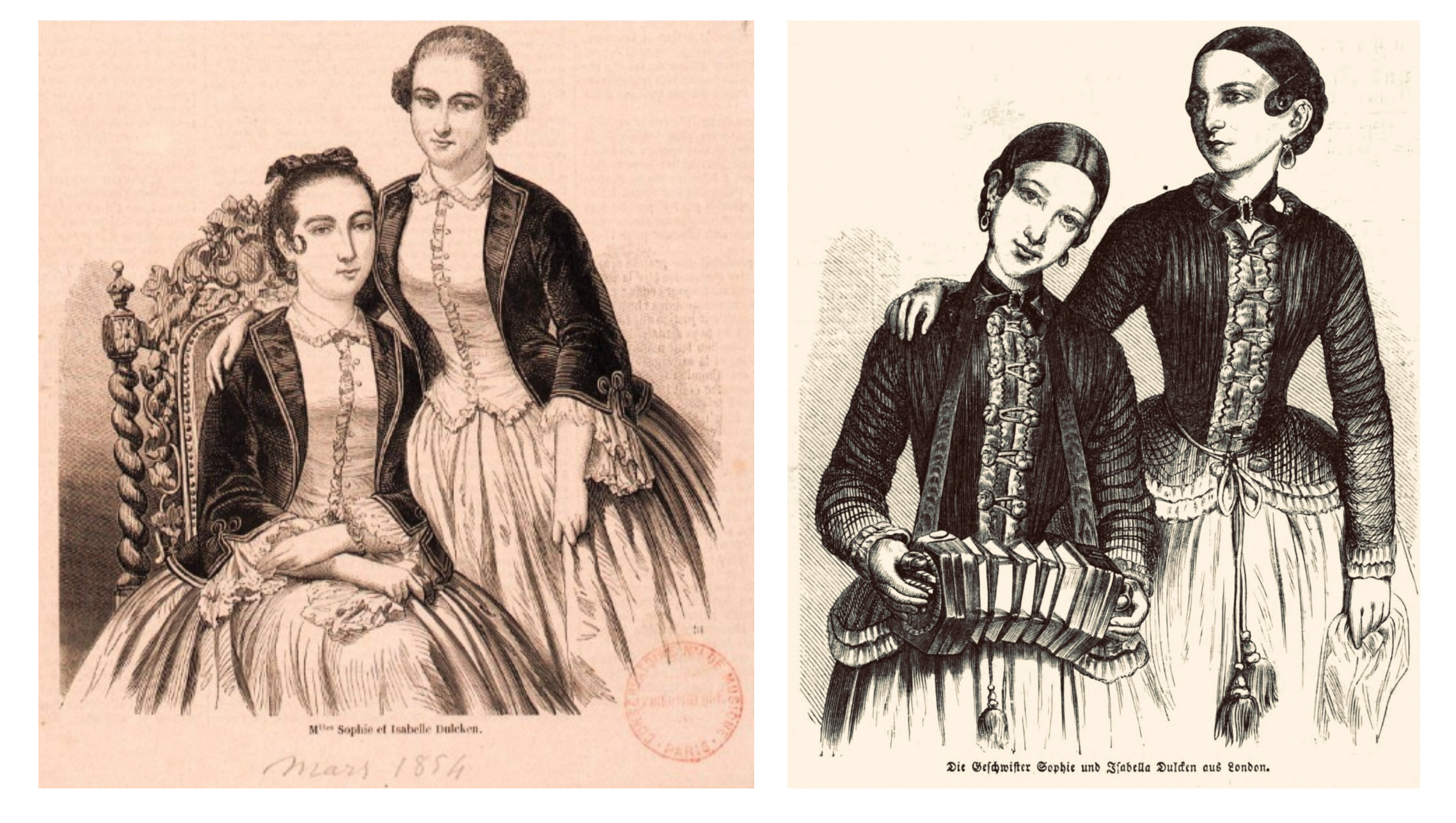
(Sarah) Isabella (Auguste) Dulcken married a gentleman called Braun.
On 15 May 1836, the concertina player was born in London, and passed away on 27 July 1899 in Munich. The individuals in question were Heinrich Dulcken, who was employed as a music teacher and organist, and Auguste née Burghaagen. It has been established that she was the sister of Sophie Dulcken and the niece of Louise Dulcken.
"Dresden. Am 26. Octbr. gab Herr Giulio Regondi im Saale van de Hôtel de Saxe ein Concert, in welchem er sich als Virtuos auf der Concertina und der Guitarre hören liess. [...] Unterstützt wurde der Concertgeber durch das Mitwirken der Frau Dulcken aus London, die sowohl im Ensemble als in Solovorträgen (Etuden von Thalberg en Mendelssohn) ihre bekannte Meisterschaft und kräftige Spielweise bewährte."
"Dresden. On 26 October 1840, Mr Giulio Regondi gave a concert in the hall of the Hôtel de Saxe, during which he demonstrated his virtuosity on the concertina and the guitar. [...] The concert was supported by the participation of Mrs Dulcken from London, who demonstrated her renowned mastery and vigorous style of playing both in ensemble pieces and in solo performances (etudes by Thalberg and Mendelssohn)."
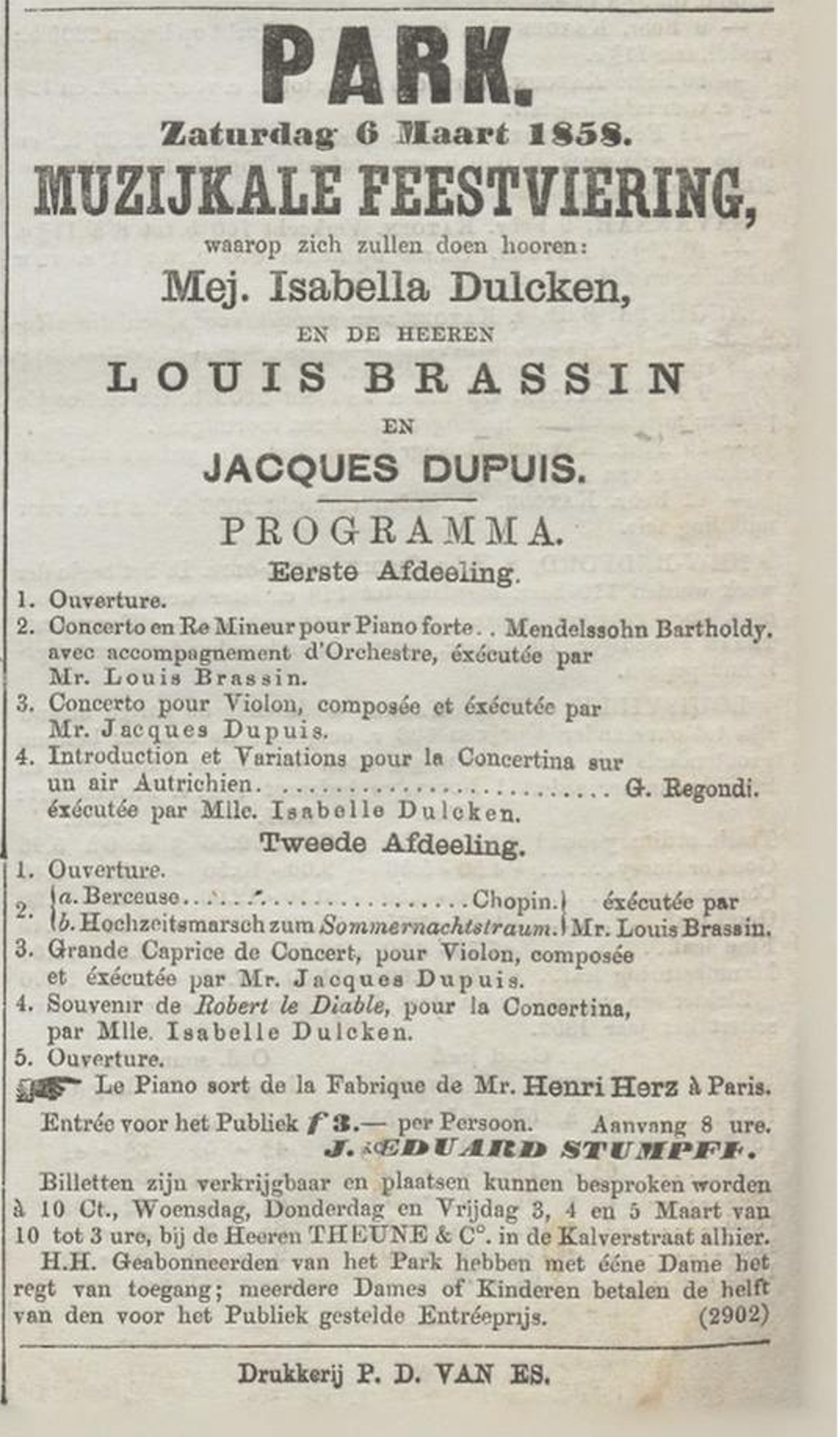
Advertentie
ecuté par Mlle. ISABELLE DULCKEN. Tweede Afdeeling. 1. Ouverture. 2. a. Berceuse, Chopin. b. Hochzeitsmarsch zum Sommernachtstraum, executé par Mr. LOUIS BRASSIN-3. Grande Caprice
Krantentitel
Algemeen Handelsblad
Datum
03-03-1858
It is evident that Isabella Dulcken was a student of Giulio Regondi (1822-1872). The temporal extent of the learning relationship remains undetermined. Between 1848 and 1854, Isabella Dulcken performed concerts in collaboration with her sister in a number of European cities, including Weimar, Vienna, Frankfurt am Main, Leipzig, Berlin, Wrocław, Warsaw, Moscow, St. Petersburg, Paris, as well as in the Netherlands and Belgium. Furthermore, she performed in concert with other musicians. In 1854, the subject established themselves in Paris with the intention of delivering educational instruction. There is compelling evidence to suggest that, as early as 1855, she had already established contact with Wheatstone & Co. In July 1864, she entered into matrimony with Johann Philipp Otto Braun (1824-1900), who had been employed as the chief editor of the Augsburger Allgemeine Zeitung for a considerable number of years. In 1865, a male child was baptised in Augsburg with the name Heinrich Alfred (died before 1894). In 1872, a female child was baptised in Augsburg with the name Sophie Ottilie Friederike Isabella (died 1894).
Her repertoire comprised original compositions for concertina by Regondi and Blagrove, as well as transcriptions of violin compositions by Artôt, Bériot and Vieuxtemps.
Isabella Dulcken is known to have assisted Giulio Regondi in the popularisation of the concertina on the European continent. The harmonica instrument was invented in the 1820s by the Englishman Charles Wheatstone. The de concertina, a musical instrument that enjoyed a high level of popularity in Great Britain, particularly among female instrumentalists, was a relatively unknown instrument in German concert halls and faced challenges in establishing itself there. Notwithstanding, Isabella Dulcken and her sister received considerable acclaim for their concerts, which they gave in German-speaking countries from 1848 onwards. In 1850, the following was written in "The Musical World" concerning a concert performed by the brothers and sisters in Munich:
„Mdlle Isabelle approaches, as nearly as possible, her excellent preceptor Regondi. We have not heard the concertina since played with so much real cleverness. The young ladies are frequently compared by their friends to the Milanollos“.
According to the Neue Berliner Musikzeitung, Isabella Dulcken had successfully extricated the concertina from the morass of triviality. Isabella Dulcken was instrumental in introducing the concertina to the French public. In a review of a series of successful concerts given by the sisters in Paris, the Neue Berliner Musikzeitung observed that the instrument, which was still in its infancy, had become extremely popular in the French capital thanks to the younger sister, Isabella.
The instrument's "curiosity" proved to be a further attraction for the concert audience, in addition to the "friendly appearance" (ibid.) of the two sisters. However, it is important to note that not all of the reviews were favourable towards the instrument. In the "Neue Zeitschrift für Musik", for instance, Isabella Dulcken's performance in Leipzig was reviewed as follows: "The performance on the concertina was of a very high standard and extremely beautiful, but the instrument is not suited to this type of concert." No further justification was provided. During a concert in Weimar, Isabella Dulcken was criticised for her "non-substantial" repertoire, or so the reports say. However, she countered this by stating that "for her instrument, the concertina, there is no better option".


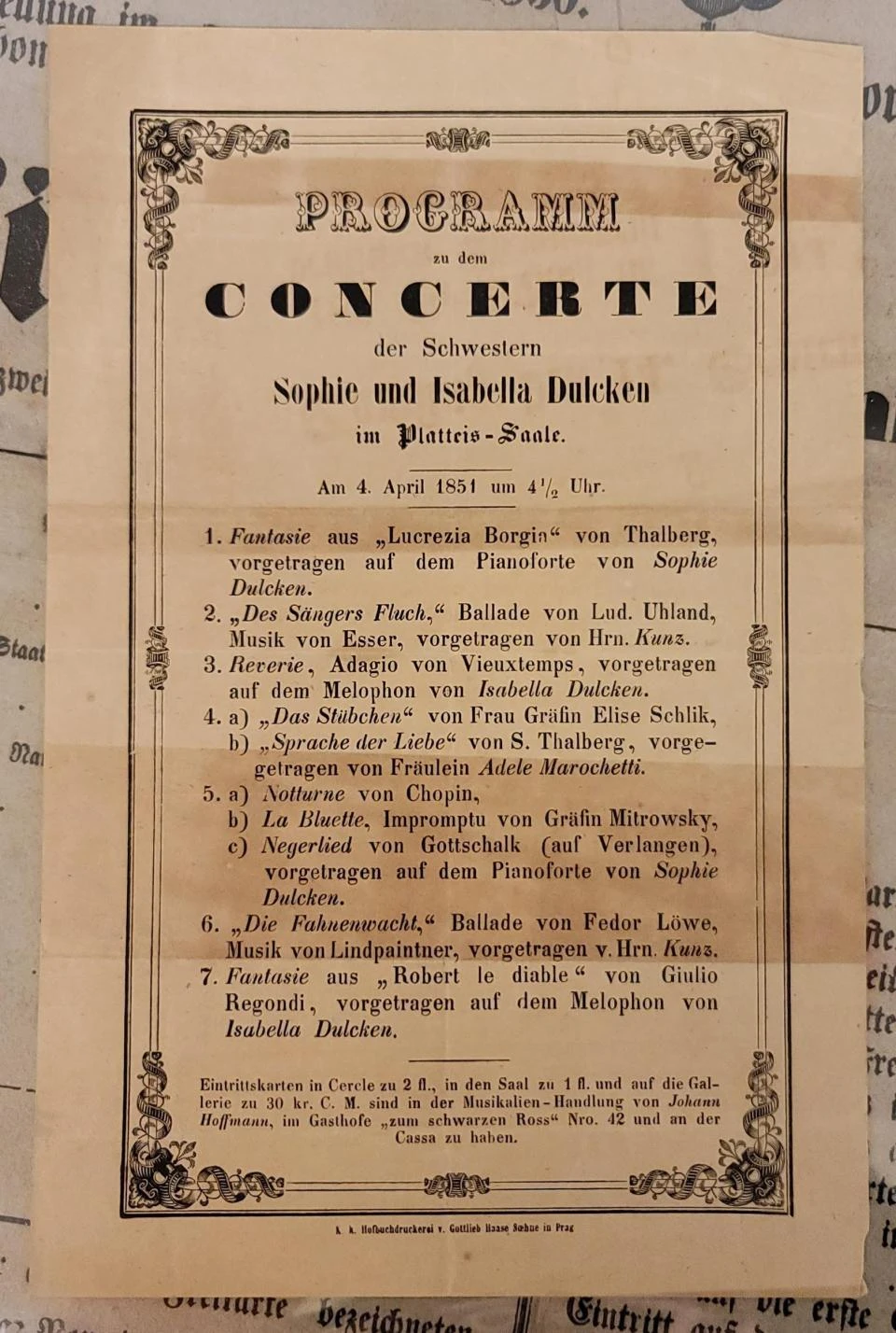
(Sarah) Isabella (Auguste) Dulcken (Londen, 15 mei 1836 – München, 27 juli 1899) was een bekende bespeelster van de concertina in de 19e eeuw.
Biografische gegevens
- Volledige naam: Sarah Isabella Auguste Dulcken (na haar huwelijk bekend als Isabella Braun).
- Geboorte: 15 mei 1836 in Londen.
- Overlijden: 27 juli 1899 in München.
- Instrument: Ze was een virtuoos op de concertina. Hoewel haar techniek werd geprezen als "heel goed", was er destijds kritiek op de geschiktheid van het instrument voor klassieke concertzalen en op het gebrek aan kwalitatief repertoire voor de concertina.
Familieachtergrond
Isabella maakte deel uit van de beroemde muzikale familie Dulcken:
- Grootouders: Johann Ludwig (Louis) Dulcken II, een koninklijke pianomaker, en de bekende pianiste/componiste Sophie Lebrun.
Haar repertoire omvatte originele composities voor concertina van Regondi en Blagrove en bewerkingen van vioolcomposities van Artôt, Bériot en Vieuxtemps.
Samen met Giulio Regondi hielp Isabella Dulcken de concertina in Europa te populariseren. Het harmonica-instrument werd in de jaren 1820 ontwikkeld door de Engelsman Charles Wheatstone. De concertina, die erg populair was in Groot-Brittannië, vooral onder vrouwelijke instrumentalisten, was een relatief onbekend instrument in Duitse concertzalen en had moeite om zich daar te vestigen. Desondanks kregen de concerten die Isabella Dulcken samen met haar zus vanaf 1848 in Duitstalige landen gaf regelmatig veel bijval. In 1850 schreef “The Musical World” over een concert van de broers en zussen in München:
„Mdlle Isabelle approaches, as nearly as possible, her excellent preceptor Regondi. We have not heard the concertina since played with so much real cleverness. The young ladies are frequently compared by their friends to the Milanollos“.
Volgens de “Neue Berliner Musikzeitung” had Isabella Dulcken “de concertina van de trivialiteit gered”. Isabella Dulcken introduceerde het onbekende instrument ook bij het publiek in Frankrijk: “De [sic] concertina, hier nog weinig bekend, werd in Parijs zeer populair door de jongere zus [Isabella]” schreef de “Neue Berliner Musikzeitung” over een succesvolle reeks concerten van de zussen in Parijs.
De “curiositeit” van het instrument was een verdere attractie voor het concertpubliek, naast de “beminnelijke verschijning” (ibid.) van de twee zussen. Niet alle recensenten waren echter gecharmeerd van het instrument. Het “Neue Zeitschrift für Musik” schreef bijvoorbeeld over een optreden van Isabella Dulcken in Leipzig: “De uitvoering op de concertina was heel goed, heel mooi, maar het instrument hoort niet thuis in deze concerten”, zonder hiervoor verdere redenen te geven. Tijdens een concert in Weimar kreeg Isabella Dulcken kritiek op haar “niet-substantiële” repertoire, zij het met het excuus dat “voor haar instrument, de concertina, nog geen beter kruid is gegroeid”.
Sophie (Louise Auguste) Dulcken, Dulken, Dulcen, married by Radziwill
6 March 1835 in London, † 15 July 1923 in Dinard (Brittany), pianist. No information is available about her education. She appeared in public in London at the age of seven with variations on Herz. In 1846, at the age of ten, she played several concerts in Leipzig, Frankfurt a. M. and Darmstadt to great acclaim. However, the ‘Neue Zeitschrift für Musik’ criticised her marketing as a ‘child prodigy’: ‘She plays the pianoforte quite well, but many things were too difficult for her, such as Thalberg's Fantasia on the Huguenots, which is why she often missed the mark. The child may have talent, but the father should not be so blind or unscrupulous as to present the little one to the world now in order to derive an immediate pecuniary advantage from the still immature fruits’. The quotation suggests that Sophie Dulcken was travelling with her father. Two years later, Sophie Dulcken went on a concert tour together with her sister, the concertina player Isabella Dulcken. Between 1848 and 1851-54, the two travelled throughout the German-speaking world.
In 1857, the ‘Neue Zeitschrift für Musik’ announced Sophie Dulcken's engagement to the Polish Prince Guillaume de Radziwill, whom she married in the same year. From then on, she refrained from public appearances. From 1863, the Prince lived in the Saint-Jean-de-Dieu psychiatric clinic in Léhon (Brittany). Sophie von Radziwill initially took up residence in neighbouring Dinard and from 1866 in Kerrosen Castle near Léhon. In this neo-Gothic castle, which she owned from 1870 to 1904, she established a musical salon where the pianist and composer Henri Kowalski was a regular guest.
Sophie Dulcken's repertoire included Mozart, Beethoven, Hummel, Mendelssohn, Thalberg, Chopin and Liszt as well as works by Joh. Seb. Bach.
• Johannes Daniël Dulcken (21 april 1706 – Antwerpen 11 april 1757) x Susanna Maria Knopffllin
• Johannes Lodewijk (Louis)Dulcken I (1735 - † tussen 1793 en 1795 München) x Catharina Koning
• Johannes Lodewijk (Louis) Dulcken II (1761 - † München 1836) [brother Johannes Dulcken ( 26 December 1768 - †?)]
Louis Dulcken x Sophie Le Brün