Foundation Musick's Monument
Jean - Herman Faber
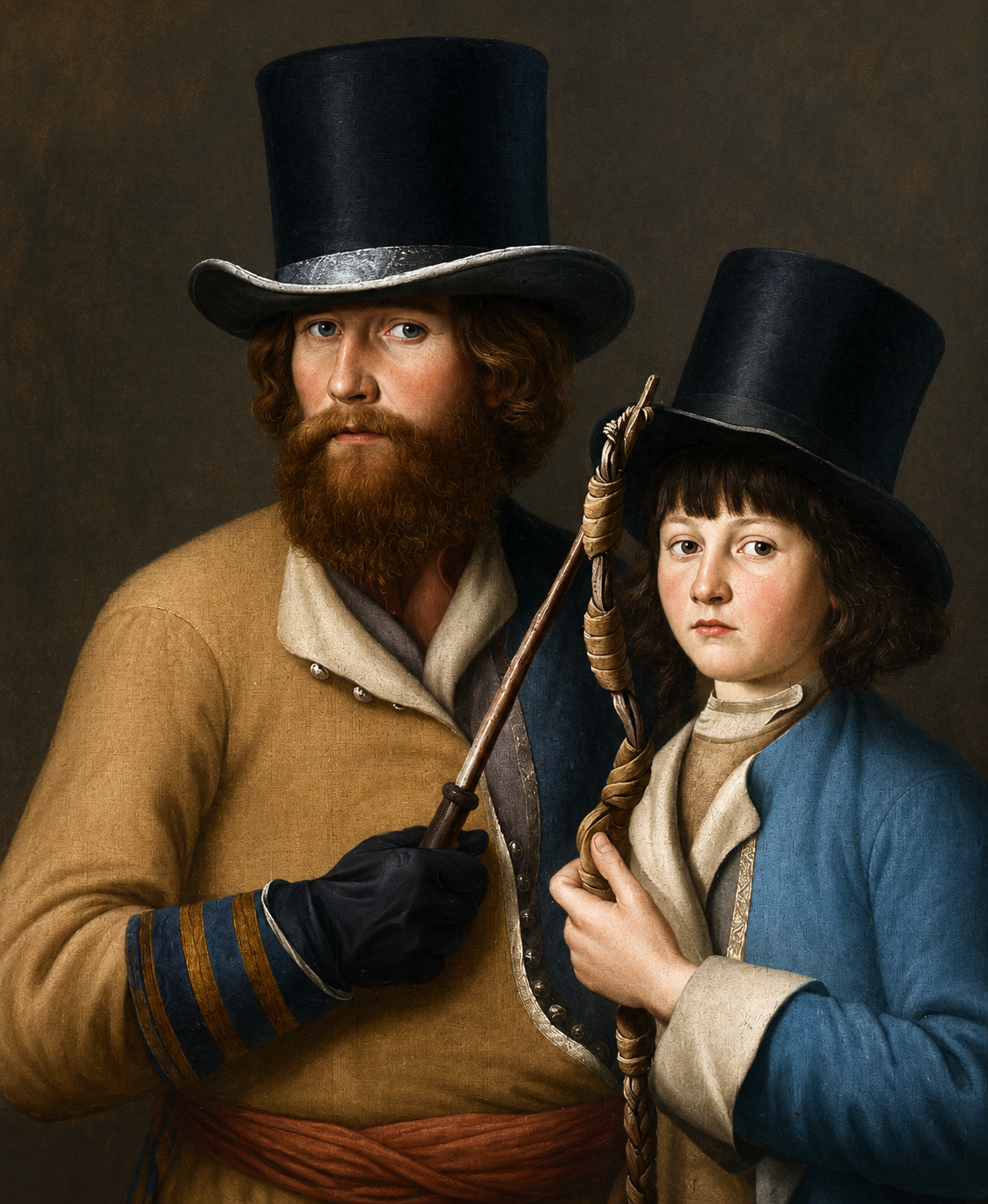
Portrait du cocher russe et le postillon du Prince Charles Joseph de Ligne
Portrait of the Russian coachman and the postilion of Prince Charles Joseph de Ligne
The Tsarina’s Driver: How a Brussels Painting Reveals the Secret Friendship of Prince de Ligne and Catherine the Great
Visitors wandering through the grand portrait gallery of Belœil Castle in Hainaut, Belgium, will eventually happen upon a highly unusual canvas by Brussels painter Jean-Herman Faber (1734–1800). There are no powdered wigs here, no stiff French military uniforms, and no allegorical Greek gods. Instead, two figures gaze out at the viewer with an intense, haunting directness: a man with a thick, dark beard and a young boy, both wearing the distinct, high-crowned top hats of Imperial Russia.
This painting depicts the Russian coachman and postilion of Prince Charles-Joseph de Ligne (1735–1814). Behind this sober, monochrome masterpiece lies one of the most glamorous and intellectually electric friendships of the Enlightenment: the intimate bond between a cosmopolitan nobleman from the Low Countries and the most powerful woman in the world, Empress Catherine the Great.
A Living Souvenir of the East
Looking closely at Faber’s work, the details speak volumes. The bearded coachman wears a heavy leather driving glove and holds a whip firmly in his hand. Next to him, his young assistant—the postilion—grips a twisted length of rope, ready to guide the horses. For Prince de Ligne, this painting was far more than a record of his household staff; it was a triumphant souvenir and an ultimate status symbol.
In the late eighteenth century, European aristocrats frequently dressed foreign servants in traditional garb to display their international reach. Yet, the presence of these Russian men in the Belgian countryside was no mere wealthy whim. The Prince had brought them back personally from the Russian Empire following the most legendary diplomatic and military adventure of his lifetime.
The Intellectual Spark in St. Petersburg
The history behind the canvas began in 1780, when Austrian Emperor Joseph II sent the charming and fiercely intelligent Prince de Ligne on a diplomatic mission to St. Petersburg. De Ligne, already celebrated across the continent as the "Prince of Europe" for his legendary wit (esprit) and galant manners, made an immediate impression on Catherine the Great.
While De Ligne was a notorious heartbreaker and Catherine had no shortage of famous lovers, their bond never devolved into a fleeting romantic affair. Instead, it blossomed into something far rarer for the era: a deep, intellectual friendship built on absolute mutual respect. Catherine, a passionate patron of the Enlightenment, found her perfect match in De Ligne. He was quickly admitted into her société intime—the highly selective inner circle that gathered in the Empress's private salons each evening to debate philosophy, trade gossip, and laugh until late into the night.
The Mythic Crimean Journey of 1787
The ultimate test of their camaraderie came in 1787. Catherine the Great embarked on her historic, triumphal progress to the newly annexed Crimea, an epic journey orchestrated by her brilliant commander (and ex-lover) Grigory Potemkin.
While hundreds of minor nobles and diplomats trailed the Imperial entourage from a distance, Prince de Ligne was one of the incredibly select few invited to ride inside the Empress’s personal carriage. For months, as the massive royal convoy rumbled across the vast Russian steppes, De Ligne sat directly opposite the ruler of the empire. It is highly likely that the very men captured in Faber's painting were out on the box, managing the reins of the imperial horses. During this journey, Catherine and De Ligne conversed for hours on the future of Europe, classic literature, and landscape gardening. The Prince captured these moments in sparkling, ironic letters back home, cementing the grandeur (and the myths of the 'Potemkin villages') into historical legend forever.
From Salons to the Battleground
Catherine’s admiration for the Belgian prince extended well beyond salon entertainment. When the Austro-Russian-Turkish War (1787–1792) broke out shortly after their journey, De Ligne took up a command as a general in the combined forces. He fought with immense bravery on the Russian front, distinguishing himself during the brutal, bloody Siege of the Turkish fortress at Ochakov.
Deeply moved by his battlefield valor, Catherine bestowed upon him the rank of Russian Field Marshal—an unprecedented honor for a foreigner—and gifted him an estate in his beloved Crimea. When De Ligne finally returned home to Belœil Castle, his Russian coachman and postilion traveled with him as living, breathing reminders of the Empress who had reshaped his destiny.
A Window into a Lost World
Jean-Herman Faber’s double portrait is much more than a painting of two anonymous servants. It stands as tangible proof of just how closely intertwined the nobility of the Low Countries was with the absolute epicenter of European power. Every time Prince de Ligne walked past this canvas in the halls of Belœil, he was instantly transported back to the endless birch forests of Russia, the thunder of the cannons at Ochakov, and that remarkable woman with whom he had shared a carriage—and a mind.
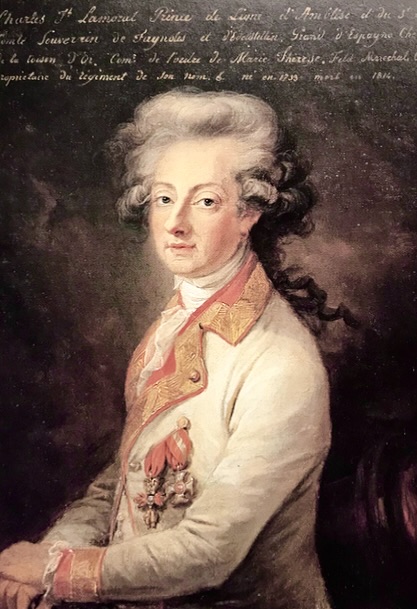
prince De Ligne
Letterlijke tekst (Frans)
Charles Jph. Lamoral Prince de Ligne d'Amblise et du St. Empire. Comte Souverain de Fagnoles et d'Edelstettin, Grand d'Espagne, Chevalier de la toison d'Or, Comr. de l'ordre de Marie Therese, Feld Marechal, Colonel et proprietaire du regiment de son nom, &c. né en 1733 mort en 1814.
(Opmerking: "Jph." is de toenmalige afkorting voor Joseph. "Comr." staat voor Commandeur. Het ampersand-teken "&c." betekent et cetera).
Engelse vertaling (English)
Charles Joseph Lamoral, Prince of Ligne, of Amblise and of the Holy Empire. Sovereign Count of Fagnolles and of Edelstettin, Grandee of Spain, Knight of the Golden Fleece, Commander of the Order of Maria Theresa, Field Marshal, Colonel and proprietor of the regiment of his name, etc. born in 1733 died in 1814.