 Foundation Musick's Monument
The Widow Dulcken: From Provisions to Prestigious Art
The Epic Life Journey Behind Jan Josef Horemans the Younger’s Masterpiece (1764)
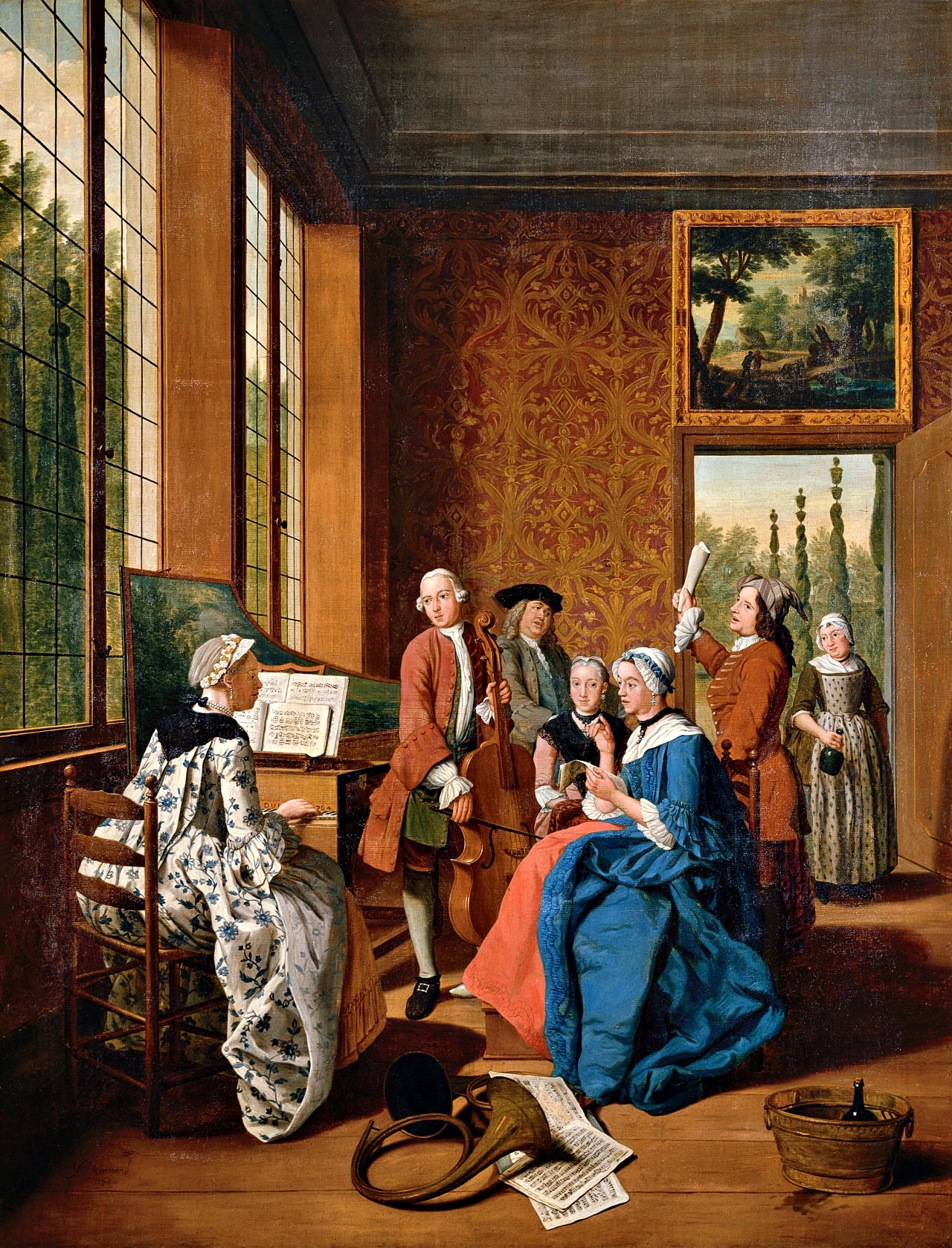
When we look at the painting that Jan Josef Horemans the Younger produced in 1764, we are not viewing a random, static snapshot. The canvas is, in fact, a masterfully orchestrated theatrical piece—a visual apotheosis of one of the most fascinating success stories in the eighteenth-century art world. Although the absence of conclusive archival evidence requires us to speak formally of an assumption, this painting projects itself so flawlessly onto the factually proven life story of the Dulcken family that the puzzle pieces fall breathtakingly into place. At the foundation of this success lies not only the craft of instrument making, but above all the unbreakable survival instinct, ambition, and commercial ingenuity of one extraordinary woman: Susanna Maria Knöpffel. Her life journey forms the true key to understanding Horemans’ masterpiece.
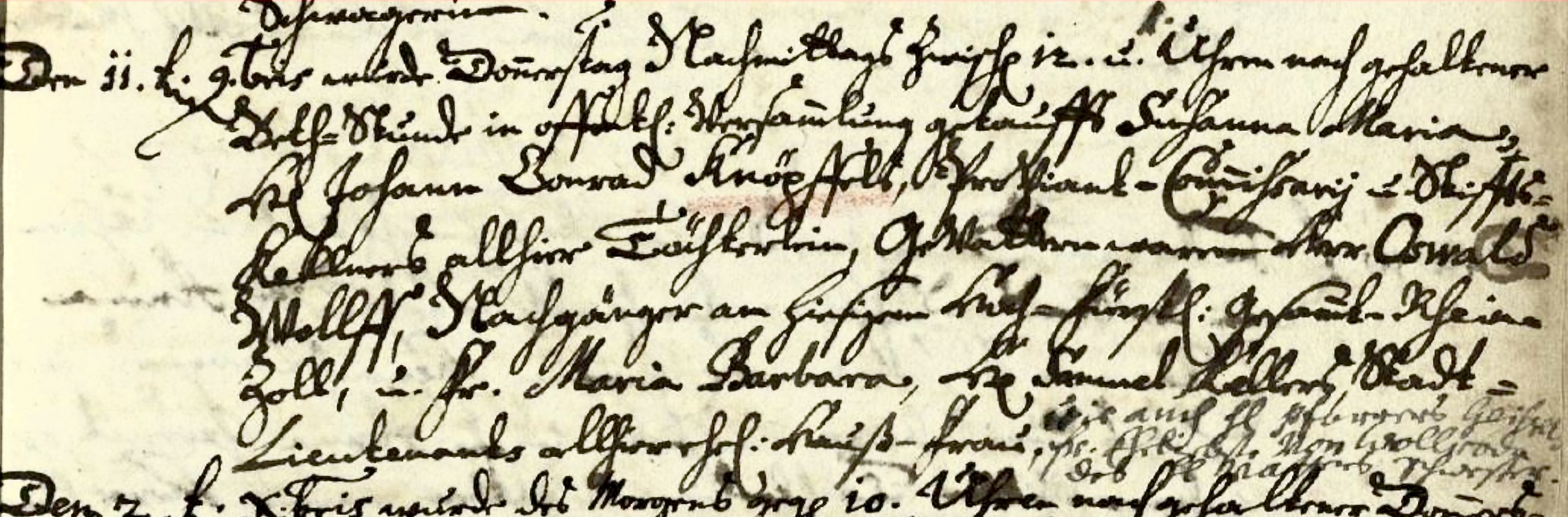
Taufeintrag Susanna Maria Knöpfel Sankt Goar 11 september 1706 - transcriptie Dr. Johannes Burkardt
Complete
Den 11 t[en] [Novem]bris wurde Don[n]erstag Nachmittags zwisch[en] 12 u[nd] 1 Uhren
nach gehaltener
Beth=Stunde in öffentl[icher] Versam[m]lung getaufft Susanna Maria,
H[errn] Johann Conrad Knöpffels, Proviant-Com[m]issarii u[nd] Stiffts=
Kellners allhier Töchterlein. Gevattern waren Herr Oswald
Wollff, Nachgänger am hiesigen Hoch=Fürstl[ichen] Gesam[m]t-Rhein=
Zoll, u[nd] Fr[au] Maria Barbara, H[errn] Samuel Kellers, Stadt=
Lieutenants allhier ehel[iche] Hauß-Frau, wie auch H[errn] Pfarrers Geissel
Fr[au] Eheliebste von Wollroda
Roots in Sankt Goar: Logistics and Provisions
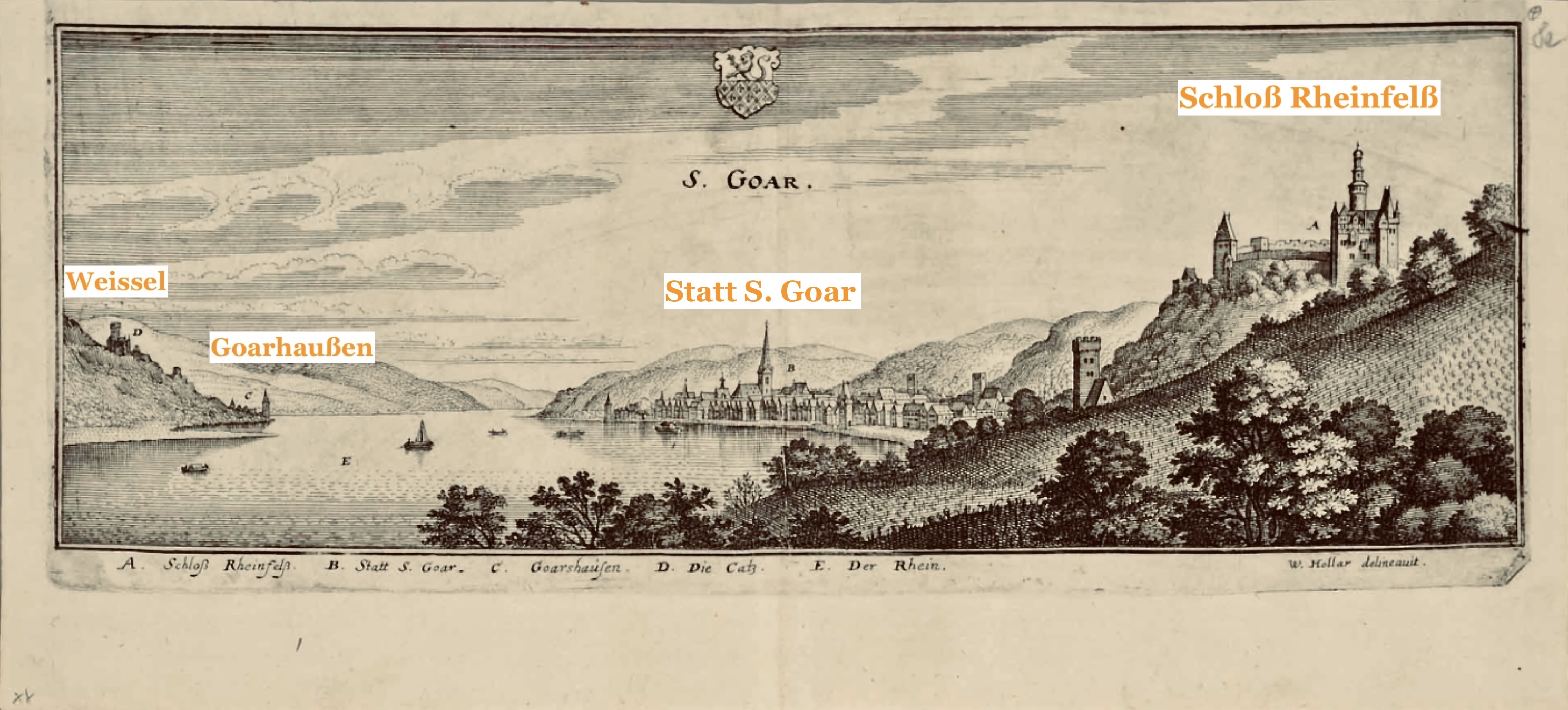
The foundation for the sharp business intuition of the later Widow Dulcken was laid far outside the Southern Netherlands, in the strategic German Rhine Valley. Susanna Maria Knöpffel was born and raised in Sankt Goar, literally in the shadow of the awe-inspiring Rheinfels Castle. Her father, Johann Conrad Knöpffel, was a major figure there, holding the influential position of proviant-commissair (provisions commissioner) and stift-kellner. Susanna’s entire youth was thus defined by large-scale trade, distribution, inventory management, and the complex logistics required to supply a giant military stronghold and its surrounding region. Here, she learned how to manage scarcity, how networks function, and how crucial strategic insight is for economic survival.
Johann Daniel Dülcken & Susanna Maria Knöpefell
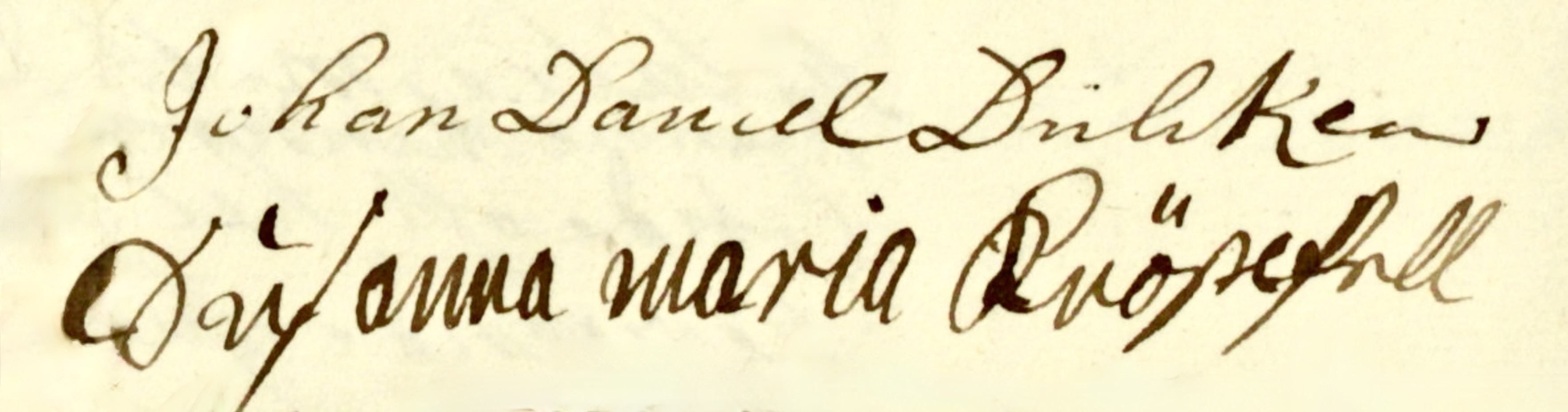

SANKT GOAR - Heiratseintrag 1733 Johann Daniel Dülcken und Susanna Maria Knüpfelin
transcriptie Dr. Johannes Burkardt
Compleet
17. [Decem]ber * Sindt H[er]r Johann Daniel Dülcken, Kauff- u[nd] Handels=mann,
H[errn] Pfarrers Dül=
ckens zu Winches=hausen (sic!) in der Graffschafft Berlenburg
Ehel[icher] Sohn, u[nd] J[ung]fer
Susanna Maria Knüpfelin, des weyland H[errn] Johann Conrad Knüpfels
gewesenen proviant=Com[m]issarii u[nd] Stiffts=Kellers allhie,
nachgelasene Ehel[iche]
Tochter, copuliret u[nd] den 23 t[en] augusti hui[us] anni zum
I stenmal p[ro]clamiret word[en].
* Darunter Eintrag mit blasserer Tinte, aber von gleicher Hand: „16. hui[us] de infra. N[ota] B[ene].“
🇬🇧 Marriage of the merchant and trader Johann Daniel Dülcken, son of the minister Dülcken zu Wingeshausen in the county of Berleburg, with Susanna Maria Knüpfelin, daughter of the deceased Provisions Commissioner and Abbey Waiter Johann Conrad Knüpfel, on December 17, 1733 (For the marriage registration of 1733, it states: Archiv der Evangelischen Kirche im Rheinland, Boppard, KB 149/1 (St. Goar ref.), p. 287.)
A Sober Beginning: Marriage in Advent
In this Rhine Valley, she met the talented instrument maker Johann Daniel Dulcken, born in Wingeshausen. On December 17, 1733, the two wed in Sankt Goar. This vow, however, carried a deep symbolism of austerity: it took place in the middle of Advent. During this ecclesiastical period of penance, a strict ban on celebrations applied; no music was allowed to play, no wine was to flow, and no large-scale wedding feast could be organized. In absolute silence, without outward display or a festive banquet, Susanna began her married life. This modest, almost ascetic beginning forms a sharp and ironic contrast with the abundance and theatrical luxury that would surround her thirty years later on Horemans’ canvas.
Fleeing the Violence
Furthermore, the Rhine Valley during this period was a geopolitical hornet's nest. Rheinfels Castle repeatedly stood at the center of brutal sieges and devastating wartime violence. Shortly after their quiet marriage, the young couple was confronted with the harsh reality of conflict and the bitter necessity of fleeing for their lives. This forced flight marked Susanna forever. It transformed the sheltered daughter of a provisions commissioner into a pragmatic, strong-willed woman with an unprecedented drive to survive. Leaving her familiar Rhine landscape behind, she and Johann Daniel set out toward the safer region of the Meuse (Maasland).
Maastricht: Financial Worries and the First Grocery Shop
The start of their joint venture in Maastricht was far from rosy. The young family struggled with acute, severe financial hardships. The urgency of their situation is clear from a document dated March 1, 1736, when Johann Daniel had to borrow 300 guilders from his cousin Gerhart Prescher at a steep interest rate of 5 percent. The promissory note was hastily drawn up by Daniel in High German—a document that would later have to be translated into Dutch in connection with a protracted legal dispute. In October of that same year, the family moved to the property 't Gulde Cruijs (The Golden Cross) on the Munt, where they opened a modest grocery shop (grutterij). Although this Maastricht period was defined by financial insecurity and legal battles, it was Susanna’s early expertise in the provisions and food trade that kept the family afloat during these lean years.
Antwerp: The Rise of the Empire and the Ykenvliet Glassware Trade
In 1738, the family left Maastricht to seek their fortune in Antwerp. It proved to be a golden move. In this historic city of art, a rare and powerful synergy emerged: the sublime artisanal talent of Johann Daniel merged with the innate business acumen of Susanna. The Dulcken workshop rapidly grew into an internationally respected phenomenon.
Susanna’s commercial drive proved early on to be an indispensable engine. She did not remain on the sidelines; proof that she never lost the sharp trading spirit of Sankt Goar is found in advertisements in the Gazette van Antwerpen around 1756. While Johann Daniel was still very much alive and building harpsichords, Susanna was already running a trade in specialized glassware and the latest bottles for the famous glassworks in Ykenvliet from their home on the Hopland. She masterfully diversified the family's financial risks. When Johann Daniel passed away in 1757, she did not have to reinvent the wheel; she seamlessly continued the glass and instrument trade, steering the enterprise through the critical transition phase with an iron hand.
Turning Point 1764: Shrinking Turnover and the Children's Inheritance for Brussels
However, the glory days in the city on the Scheldt were not everlasting. In the early 1760s, following her husband's death, the turnover of the Antwerp workshop steadily declined. Susanna realized that a radical, strategic step was necessary to save the family business: a relocation to Brussels, the courtly and aristocratic capital of the Austrian Netherlands, where wealthy courtiers and nobles resided.
And that brings us to the crucial year of 1764. At this moment, the widow was still fully based in Antwerp, in the midst of the hectic preparations for the grand move. To finance this daring fresh start, she took a step that was as pragmatic as it was profound: she formally petitioned the Antwerp magistrates (schepenen) for early access to her minor children's inheritance. This capital was a bitter necessity for relocating the business; her intention was to immediately invest the money in purchasing precious tone wood and specialized components to successfully launch harpsichord production on a grand scale in Brussels.
The Parlor as a Showroom Ahead of Departure
Because a harpsichord was an incredibly expensive elite product in this era, a buyer would never purchase one purely 'on sight'. A customer had to personally hear, play, and test the instrument's tone, touch, and registers. Since no public sales advertisements for their harpsichords can be found in the Antwerp archives, it is probably that sales took place entirely at home. The family's opulent reception room in Antwerp was therefore likely much more than a private space: it was a carefully curated, exclusive showroom. Here, in the intimacy of her own salon—the very room Horemans captured probably this exact transition year of 1764—the Widow Dulcken received royals, nobles, and wealthy burghers to let them judge the unparalleled sound of her instruments in absolute luxury.
The painting therefore captures the family at a historic crossroads. It stands as the ultimate visual summary of their Antwerp period, painted at a moment when their gaze was already resolutely fixed on Brussels. It depicts Susanna Maria Knöpffel not in decline, but at the height of her strategic power: the vital architect who, using the released inheritance money, secured both the future of her children and the survival of her prestigious art.
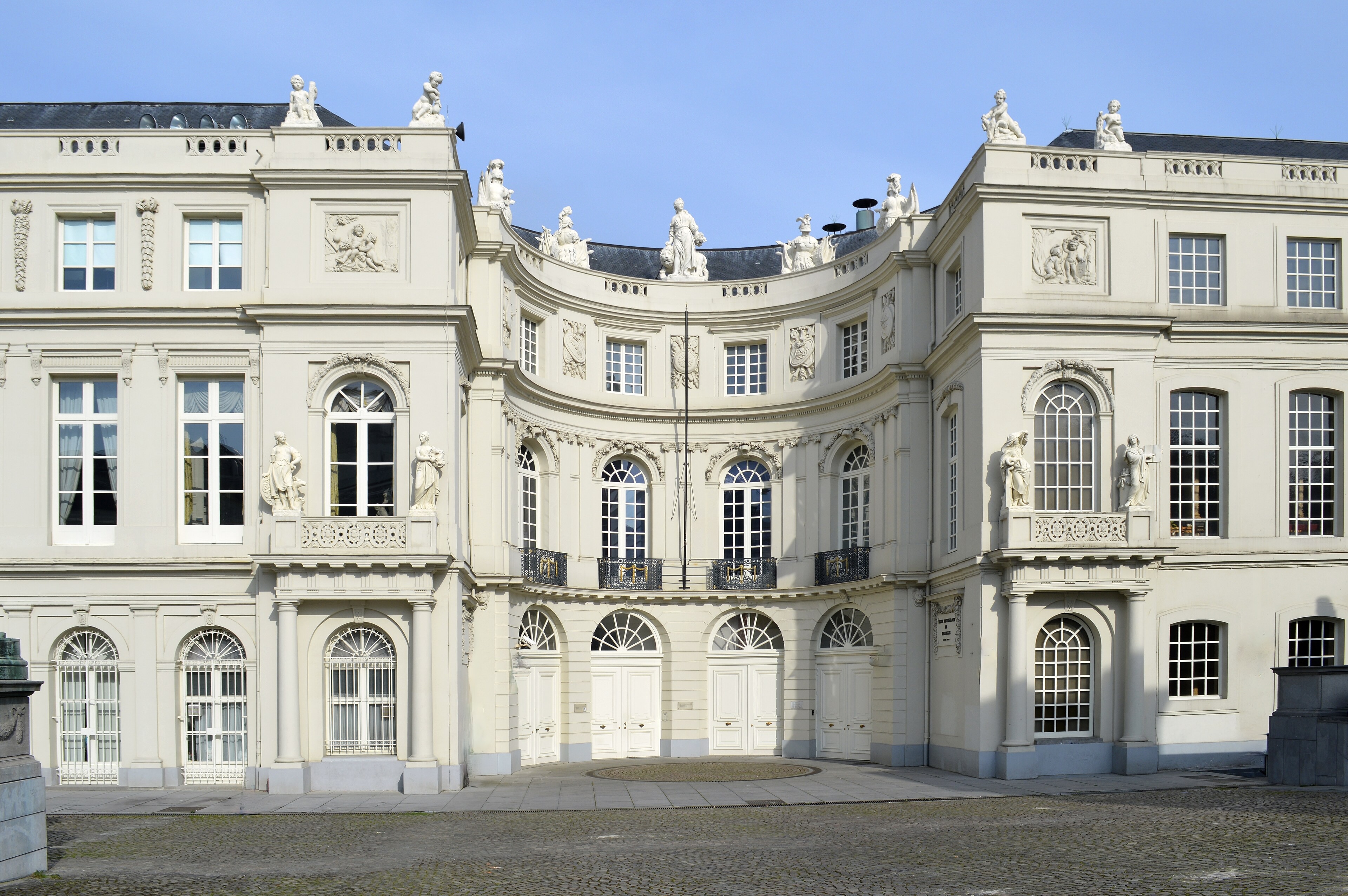
Palace of Charles of Lorraine, Brussels
INFO
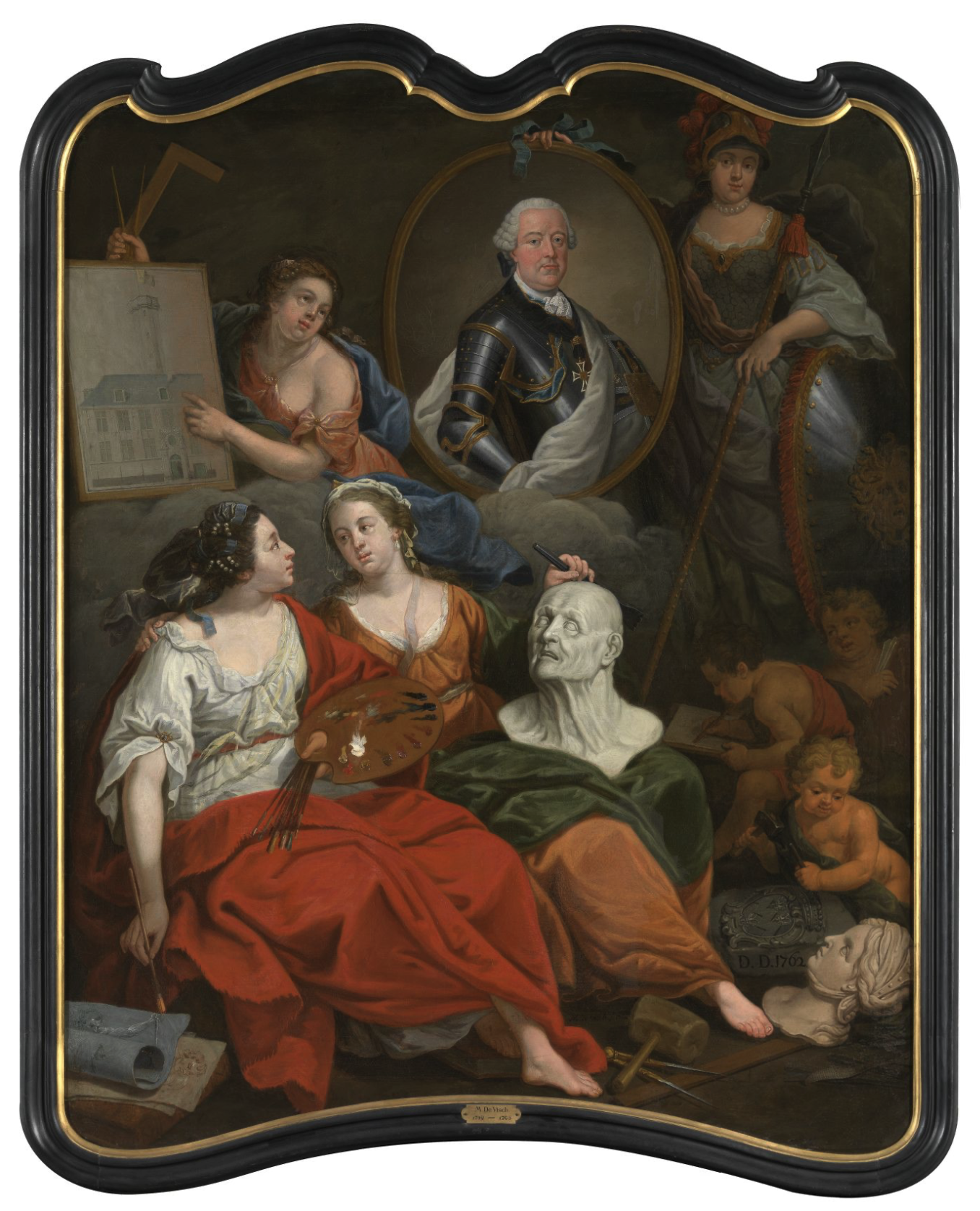
Charles of Lorraine as Patron of Arts - Mattias de Visch
Description
A bust of the governor Charles of Lorraine in an oval medallion held by Minerva. To the left of the medallion and below it, three female personifications can be seen: Architecture, holding a compass and set square and pointing to a drawing of the Poortersloge where the Bruges Academy was based; Painting, holding a brush and palette, with study drawings on the ground beside her; and Sculpture, holding a chisel and working on a bust. On the far right are three young boys: each of them is intended to represent the practical training involved in one of the three arts: one boy is holding architectural plans, the second is drawing, and the third is chiselling a coat of arms into stone. The latter can be identified as the coat of arms of Pieter-François-Vincent de Vooght, High Bailiff of Bruges.
Charles of Lorraine as Patron of Arts
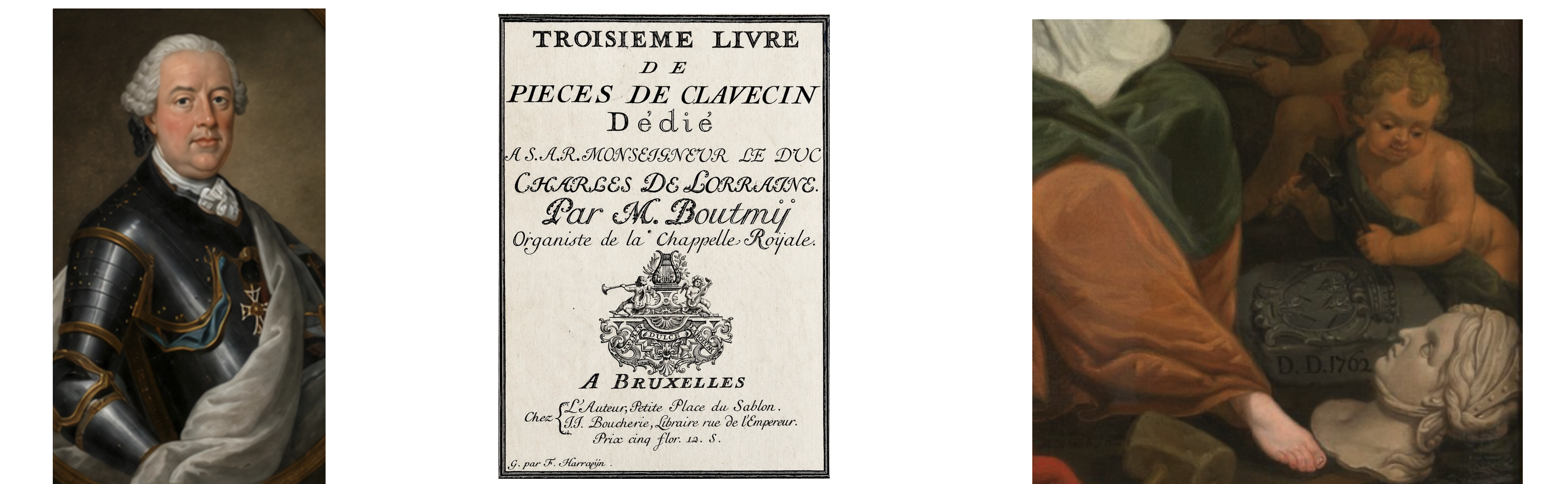
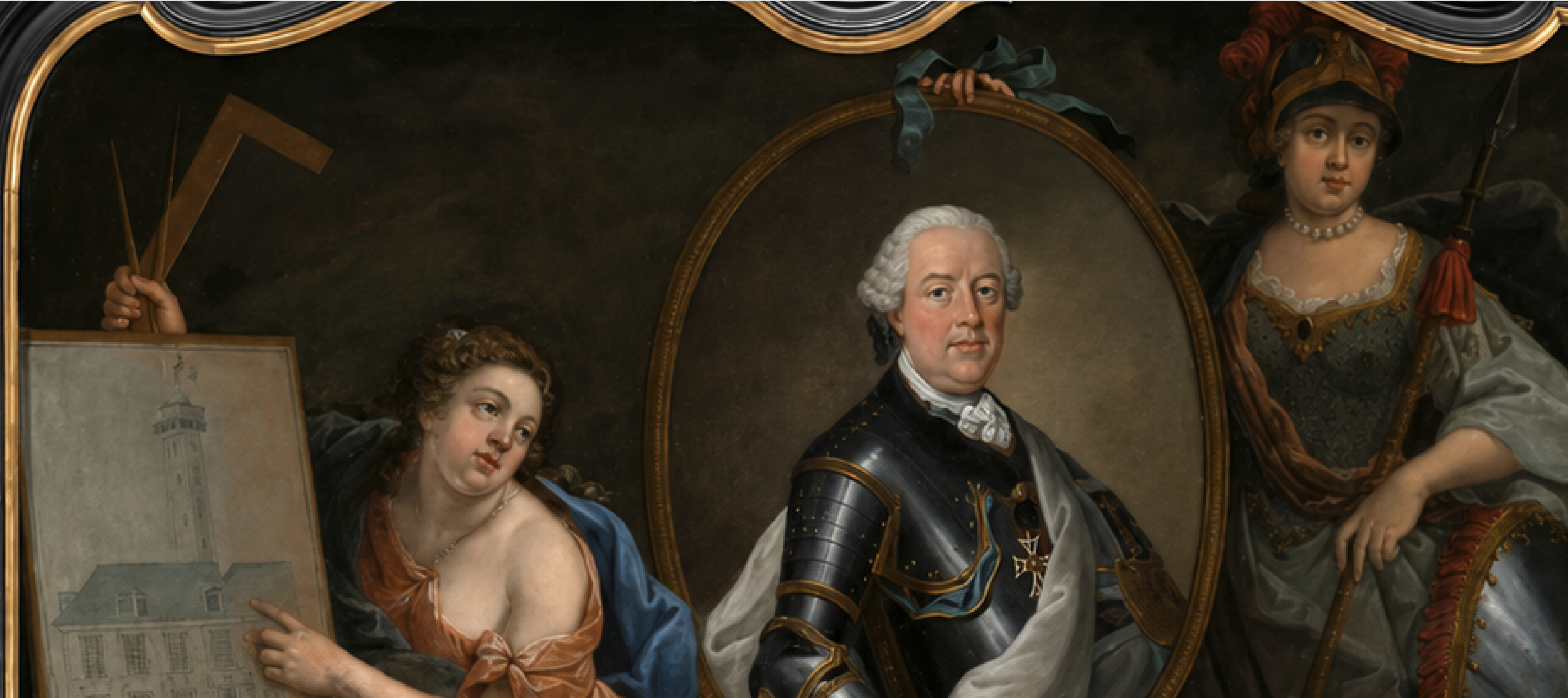
The Dulcken harpsichord in the painting by Jan Jozef Horemans (1764)
A new interpretation of a remarkable detail
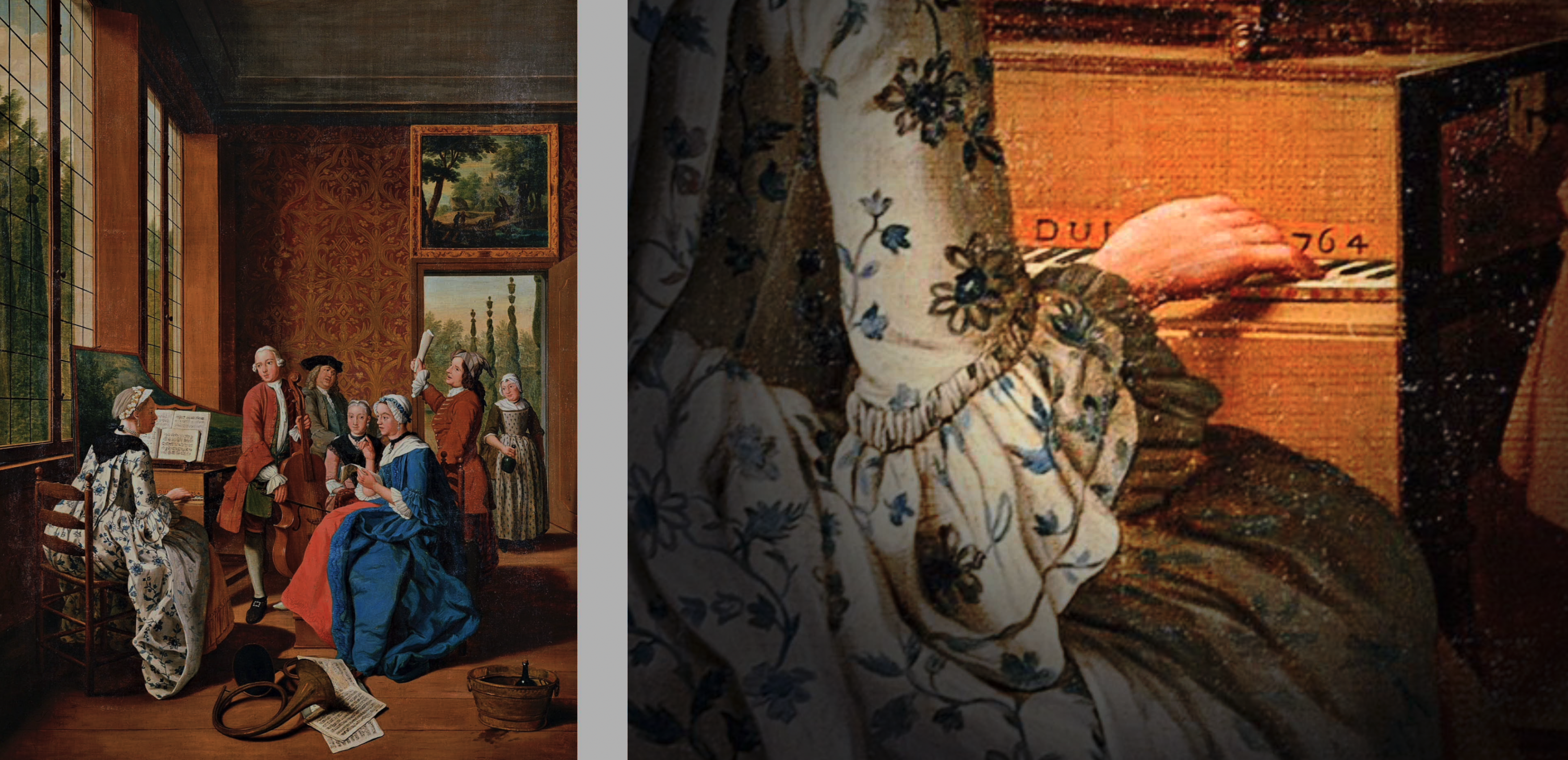
signed and dated lower left: J Horemans 1764 on the floor
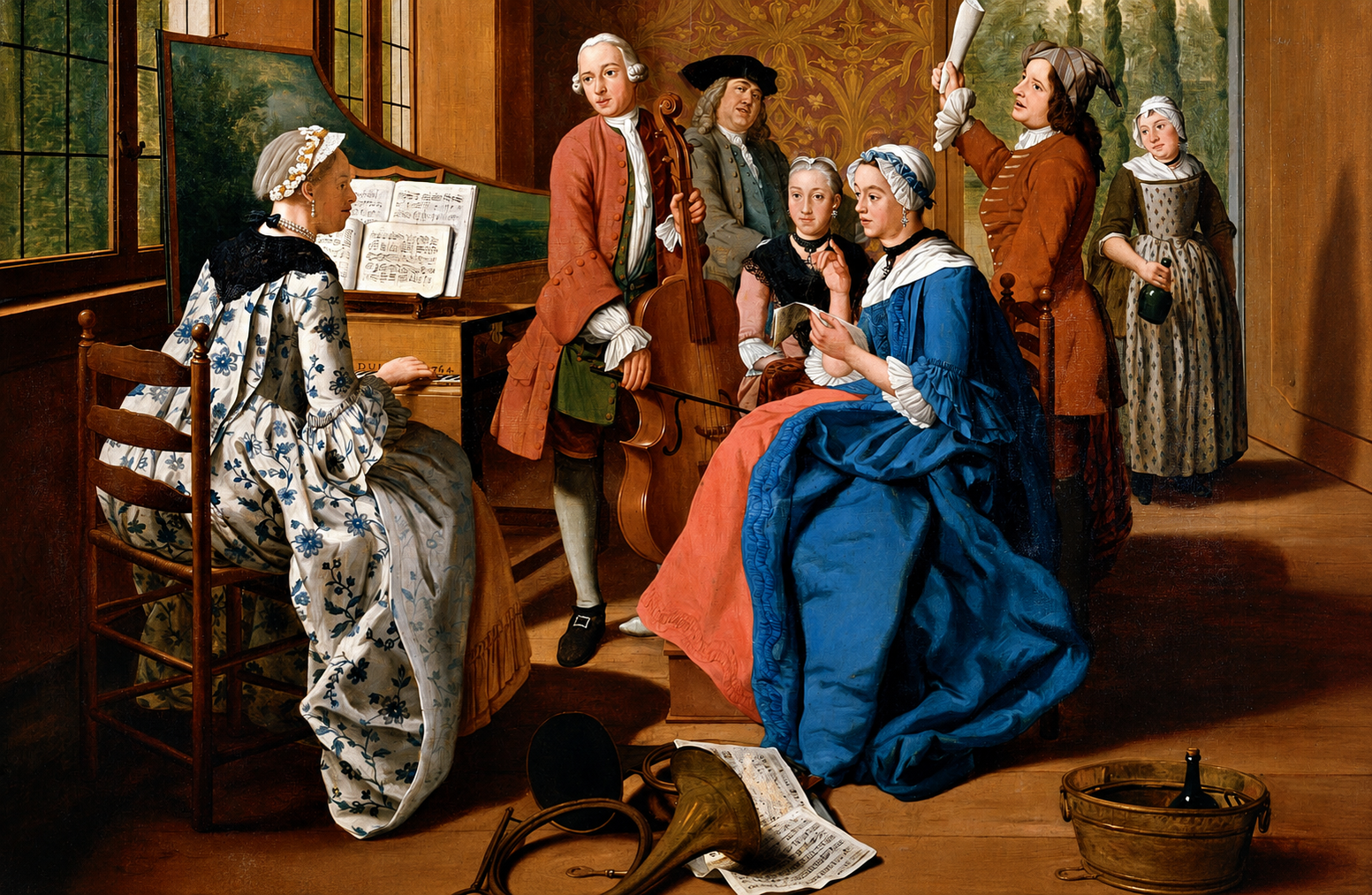
This interior scene by Jan Jozef Horemans the Younger, dated 1764, is one of the finest depictions of an eighteenth-century musical ensemble in Antwerp. At first glance, it appears to be an elegant genre scene in which a few musicians are playing together. On closer inspection, however, a remarkable detail stands out which has received little attention to date.
The name ‘Dulcken’ is clearly painted on the harpsichord.
This is a remarkable fact. Horemans could easily have simplified the signature or rendered it completely illegible, as artists in the eighteenth century often did when a brand name or inscription had no substantive meaning. In this case, however, the name appears to have been deliberately rendered legible. This suggests that the instrument is more than a decorative object: it may well form an important part of the depiction.
The name almost certainly refers to the famous Antwerp harpsichord maker Johannes Daniël Dulcken (1706–1757), whose instruments were among the most highly regarded in Europe during the eighteenth century. Following his death, his workshop continued to be run by his widow Dulcken (Susanne Maria Knöpffel), her son-in-law Jean Hermanus Faber, and his youngest son Johannes Dulcken.
It is precisely the painting’s date that makes this detail particularly interesting. In 1764, Johannes Daniël Dulcken’s children were young adults:
• Joanna Henrietta (aged 27)
• Maria Sophia (aged 24)
• Joannes (aged 21)
• Joanna Elizabetta (aged 17)
These ages correspond remarkably well with those of the young musicians depicted by Horemans.
Johannes Daniël Dulcken’s eldest son, Johannes Lodewijk, was working independently in Hasselt (Overijssel) in 1764
The year 1764 also marks the company’s relocation to Brussels, as evidenced by the document below from the Antwerp archives.
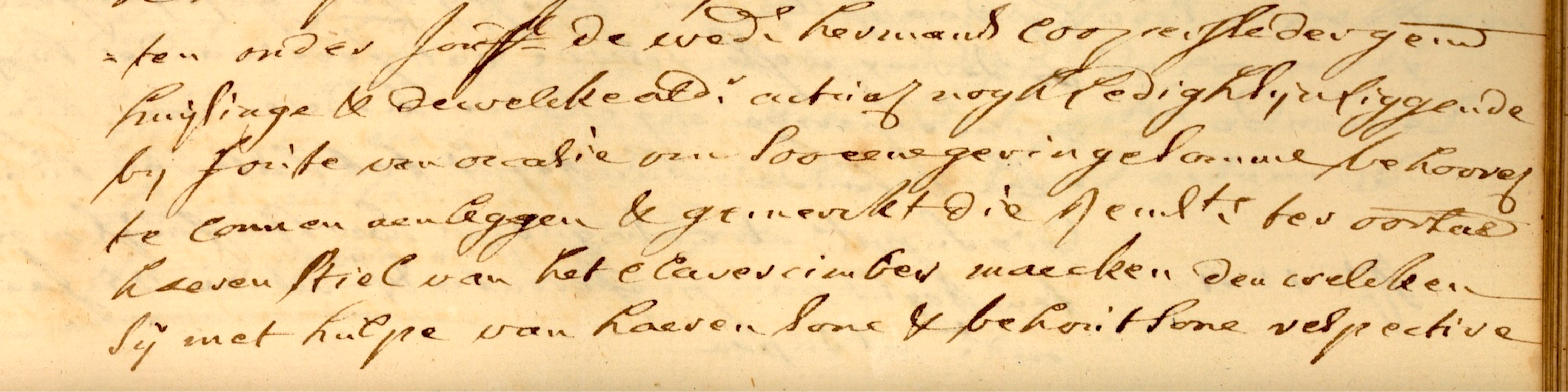
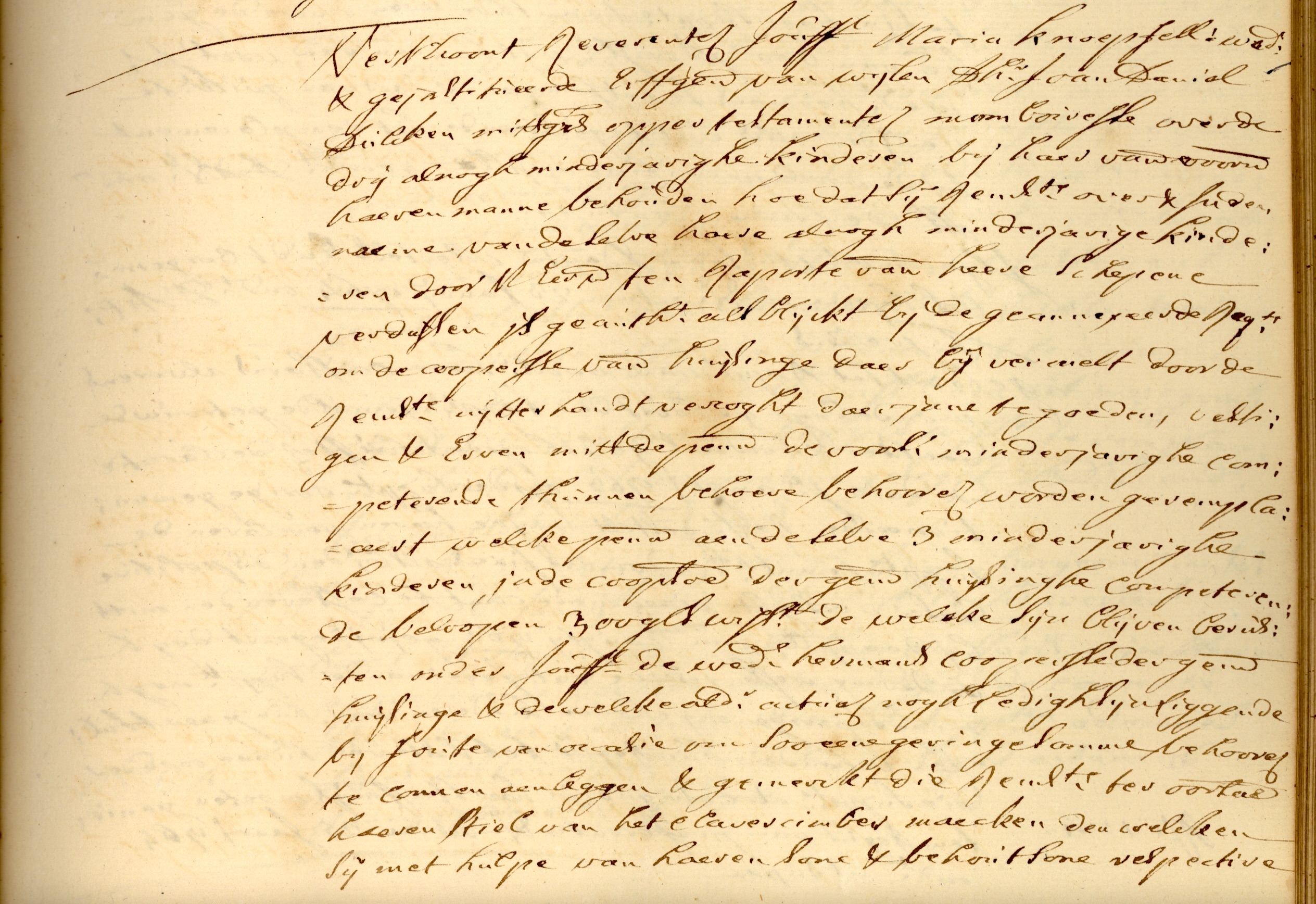
=ten onder Joffr: de wed: hermans cooreman der geverts
huijsinge & dewelcke aldaer actieff nogh ledightgeunliggende
bij faute van occasie om soo een geringe somme behoorev:
te connen aenleggen & gemerckt die sélve ts: haeren
cooren stiel van het clavescimbel maecken den welcken
sij met hulpe van haeren sone & behout sone respective
(Opmerking bij de transcriptie: "ledightgeunliggende" is een wat slordig geschreven variant van "ledig en onnut liggende" (ongebruikt liggen). "ts: haeren cooren stiel" staat voor "tot haren verkoren stiel/korenstiel" (haar voornaamste of gekozen beroep). "behout sone" betekent schoonzoon).
Modern English
...under Miss, the widow of Hermans Cooreman, in the aforementioned house, and which currently still lies there unused due to the lack of opportunity to properly invest such a small sum; and considering that this concerns her chosen trade of harpsichord making, which she, with the help of her respective son and son-in-law.
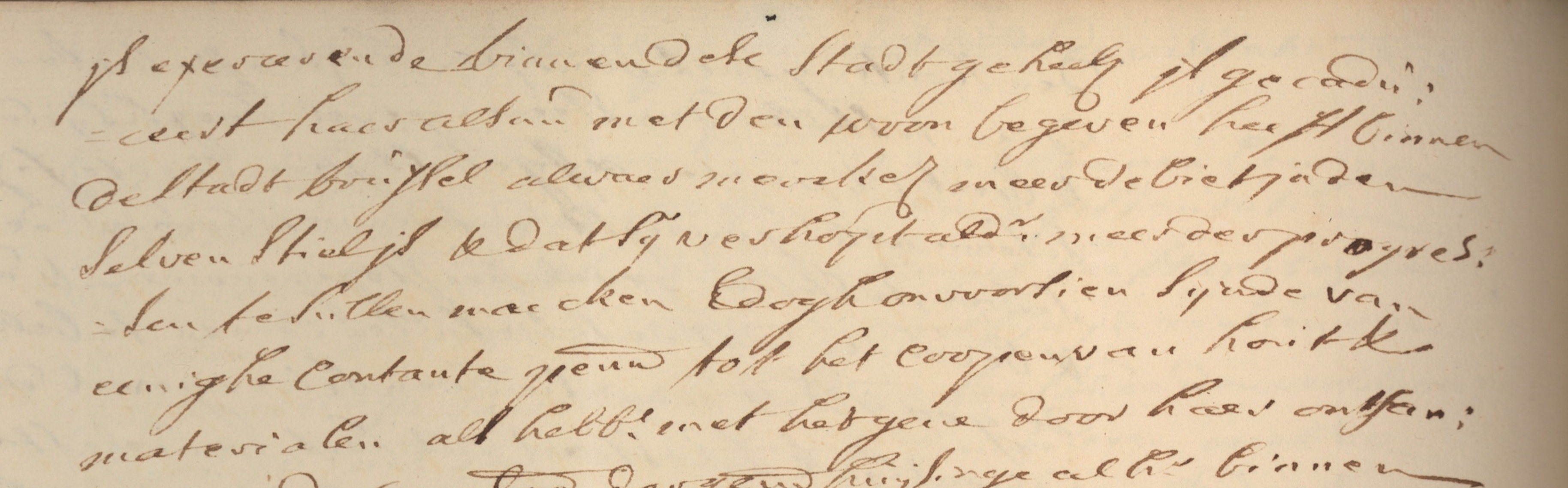
=eerst haer alsoo met den soon begeven heeft binnen
de Stadt brussel alwaer merckelijck meer debiet jnden
selven stiel is & dat sy verhopt aldaer meerder progres=
=sen te sullen maecken Doch onvoorsien synde
van eenighe contante penn: tot het coopen van hout &
materialen. als hebb: met hetgene door haer ontfan:
..[she] was completely advised against practicing [her trade] within this city; [and] has therefore first gone with her son to the city of Brussels, where there is noticeably more demand/turnover in that same trade, and where she hopes to make greater progress. However, being unprovided with any cash for the purchase of wood and materials, having [spent/done] with what was received by her..
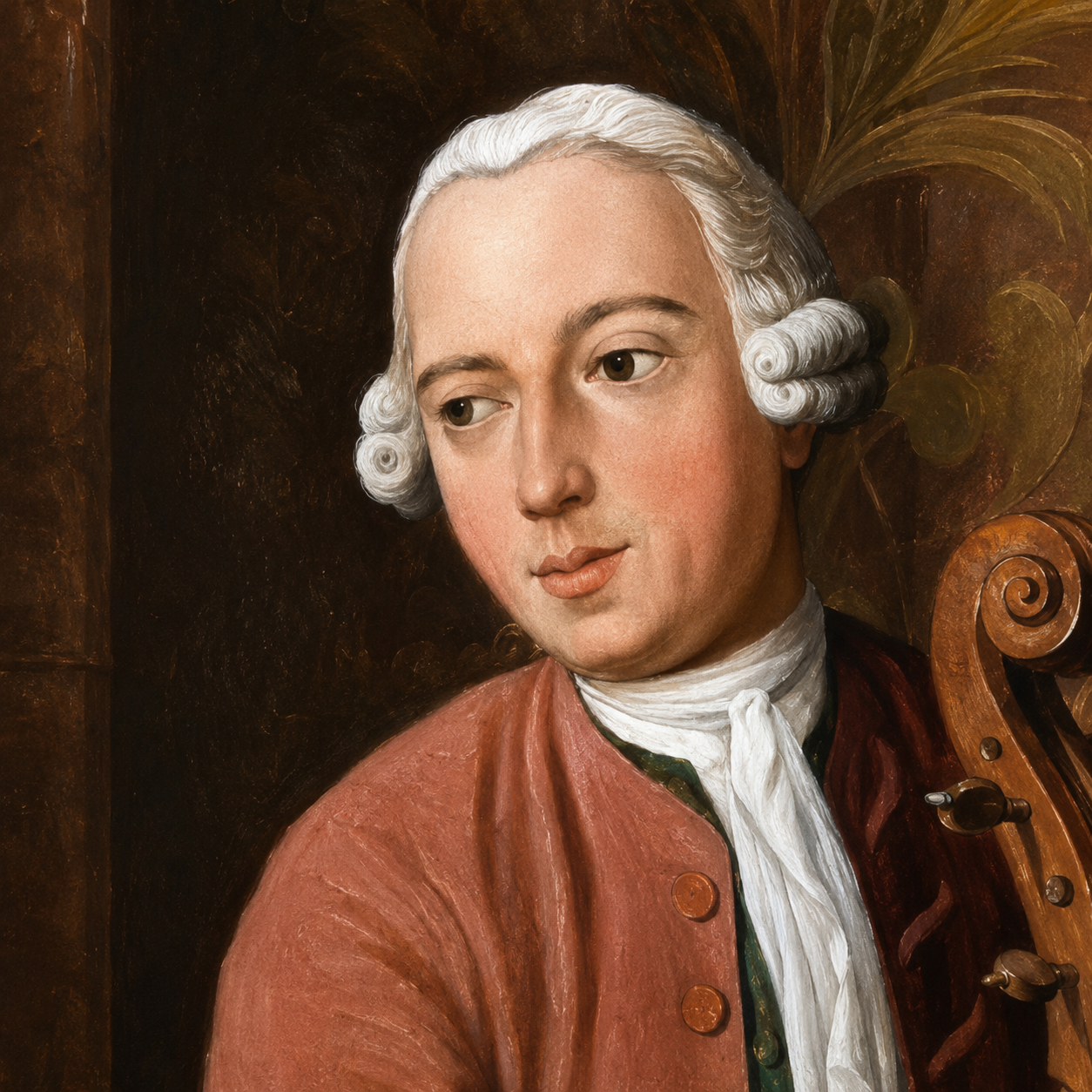
When, in addition, the possible portrait likenesses are taken into account – including the identification of the young cellist as Joannes Dulcken and, behind him, possibly Jean Herman Faber (a pupil of J. Horremans!) – an intriguing hypothesis emerges. The painting would then not merely depict a random group of musicians, but a circle of family and friends associated with the famous Antwerp harpsichord makers.
There is currently no direct archival evidence to support this interpretation. Nevertheless, the combination of the clearly painted name ‘Dulcken’, the painting’s date, the ages of the children and the portrait comparisons forms a coherent whole that merits further art-historical research.
Should future research confirm this hypothesis, Horemans’ painting could emerge as one of the earliest known family portraits of the famous Dulcken dynasty of Antwerp harpsichord makers.
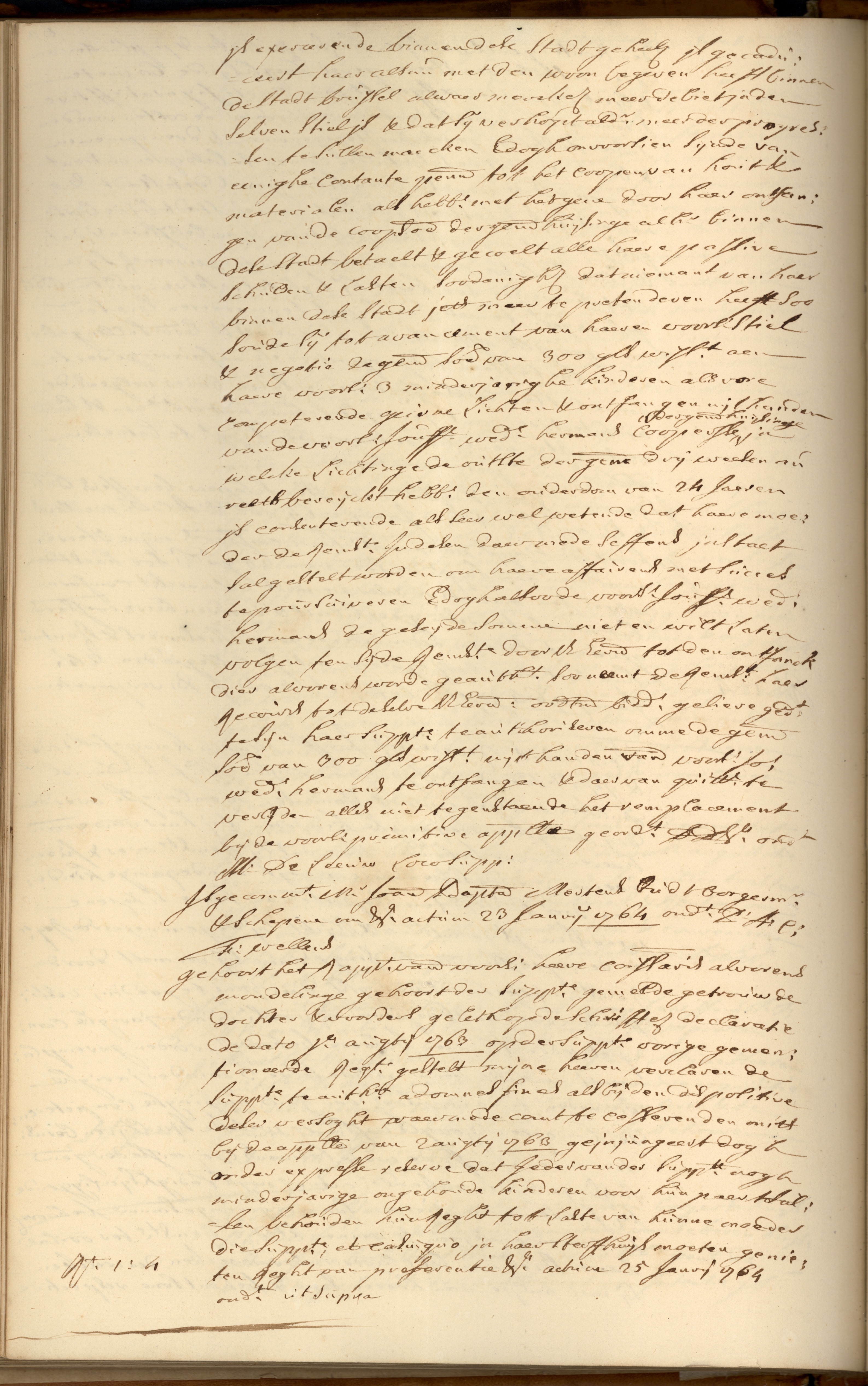
Respectfully shows Miss Maria Knöpffell, widow and designated heir of the late Mr. Joan Daniel Dulcken, as well as testamentary guardian over the three still minor children left behind by her aforementioned deceased husband.
She explains that following the death of her husband, she has entirely relocated the practice of the craft of harpsichord making—which she carries out with the help of her son and son-in-law respectively—to the city of Brussels, as there is a greater market demand ("debit") for the said craft there, and she hopes to achieve greater progress there.
However, being currently unprovided with ready cash for the purchase of wood and materials, and since she has fully paid off all her passive debts and expenses within the city of Antwerp using the previous proceeds from the sale of their house (sold to the widow Heymans)—meaning no one in Antwerp has any further claims against her—she requests to withdraw and receive the sum of 300 guilders (specie/exchange money) currently held for her three minor children. The eldest of the children (24 years old) already consents to this, well knowing that their mother will thereby immediately be enabled to successfully carry on her business.
Since the widow Heymans refuses to release the said sum unless the petitioner is authorized by your honors (the Magistrates/Aldermen), she dejectedly turns to you, humbly praying that you please authorize her to receive the said sum of 300 guilders against a proper receipt.
Dated, 23 January 1764.
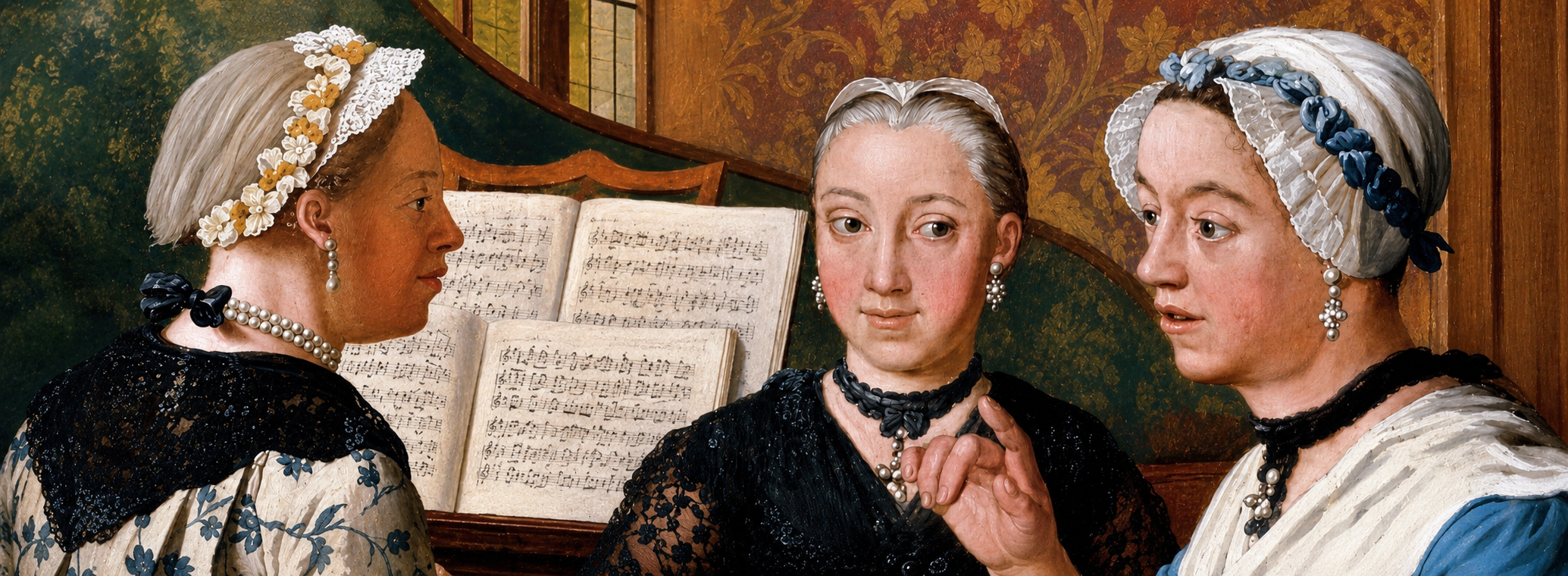
The ladies side by side for comparison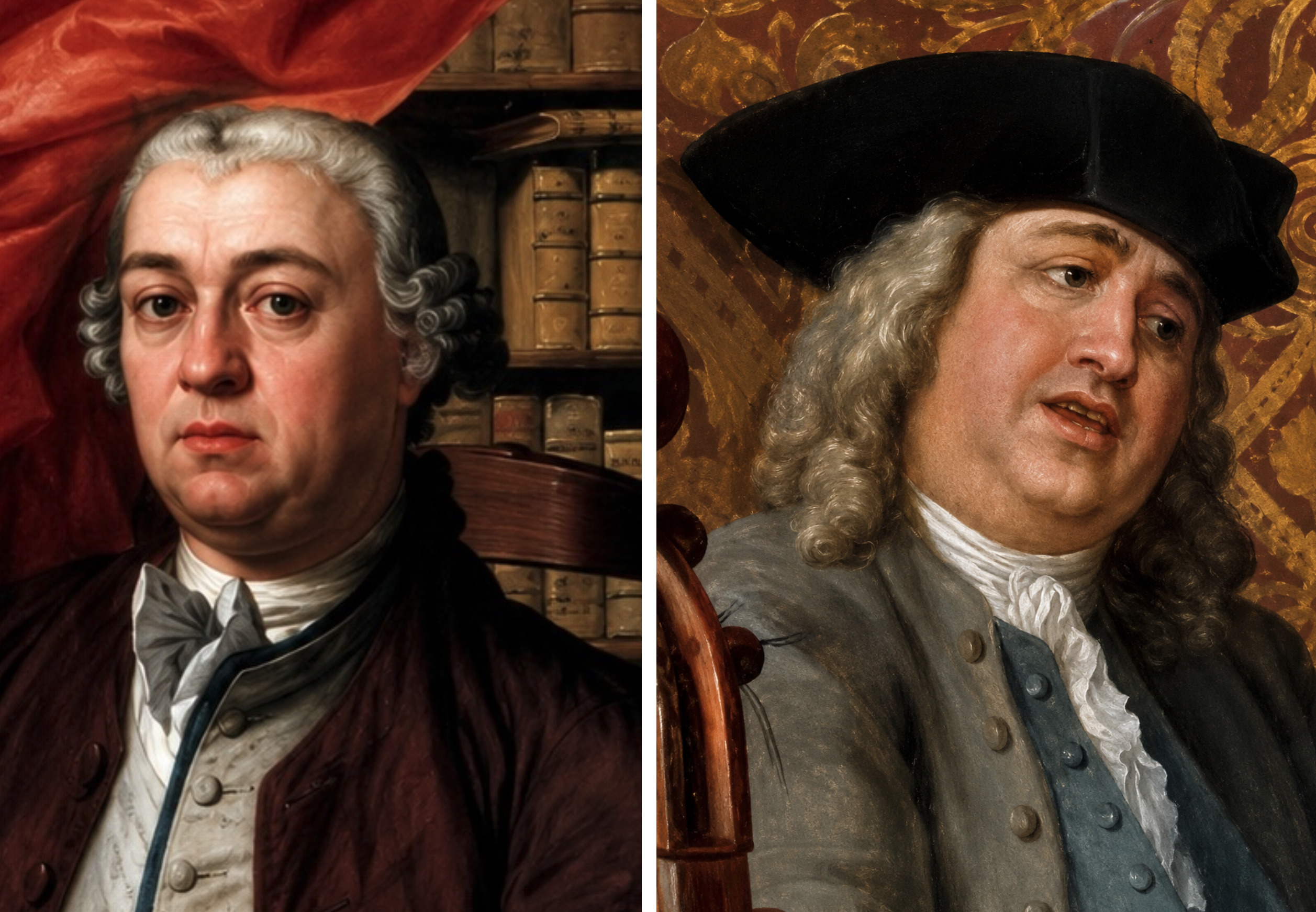
On the left: Jean Herman Faber – self-portrait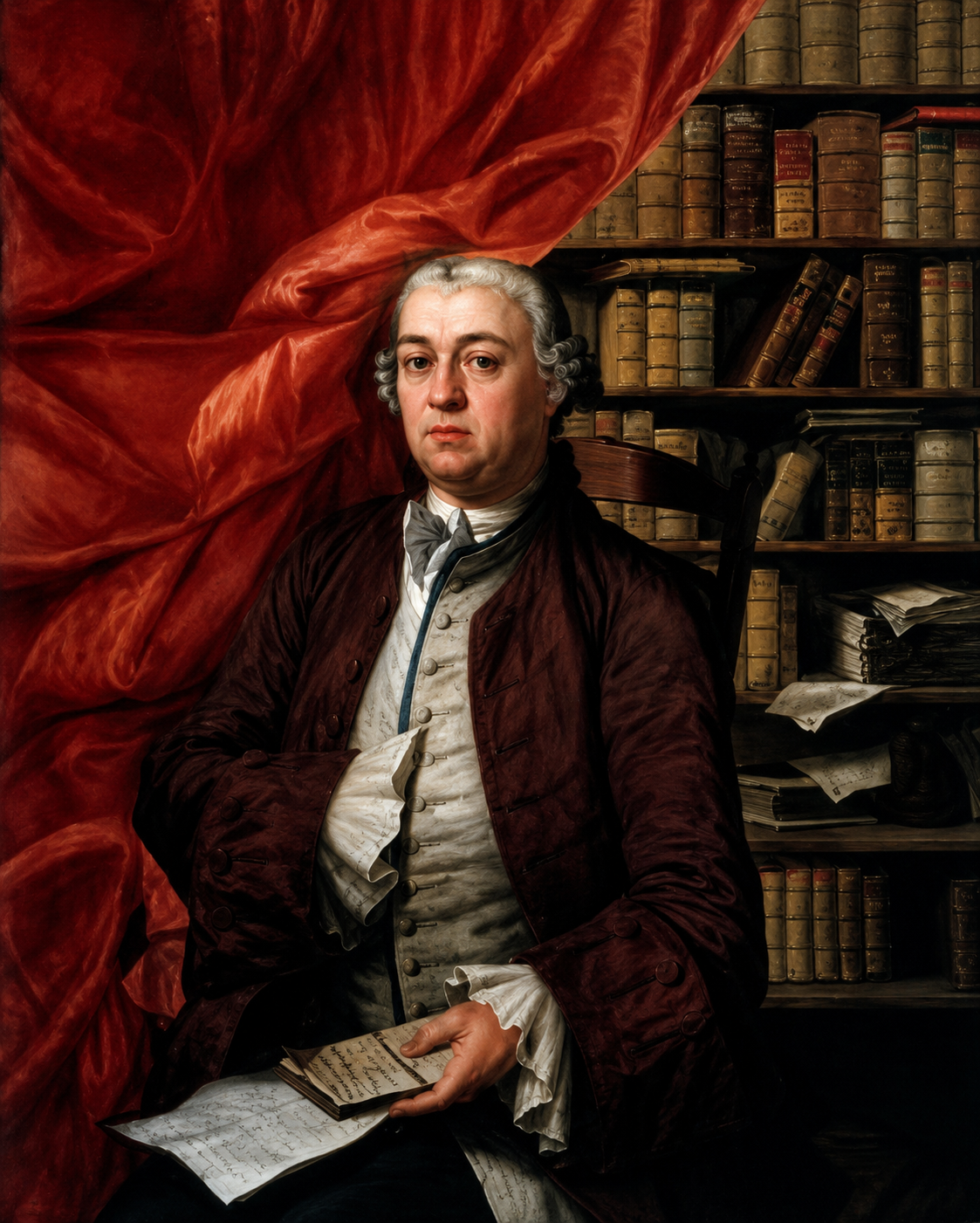
Johan Herman Faber (1734-1800)
Portrait of a gentleman, possibly a self-portrait of the artist, standing small three quarter length in a library by a curtain, wearing a beige waistcoat with lace chemise, brown jacket and wig, holding a document in his left hand
indistinctly signed and dated Joh. Herman Fab../pinxit.1759 lower right and inscribed 16 Febr.1759/Testament van/Sr J.H. Faber. on the document
oil on canvas
48.5 x 41.8 cm
Johann Hermann Faber was admitted to the Gilde of Saint Luke of Antwerp in 1753 and enrolled at the Academy of Antwerp in 1757 with the mention: "from Ludenscheyt in Westphalia, living in Elberfeldt". He obtained a third place there, behind François-Louis Lonsing and Mets and a prize in 1759. He was also a student of Jan Josef Horemans (II).
Based in Brussels, he took part in the founding of a free academy. Married with Joanna Henrietta Dulcken. He is the father of Frédéric Théodore Faber, who was also his student.
The Brussels City Museum holds an ‘Alcibiades’ (signed and dated 1789). Nevertheless, his works are very rare; one can discern a kinship with 17th-century Antwerp artists, such as the Franckens.
- Kerk Sint-Jan den Doper ter Begijnhof (Brussel)
- Museum van de Stad Brussel (Brussel)
- P. Bautier, Peintres bruxellois du XVIIIe siècle, Bruxelles, 1949.
- D. Coekelberghs et P. Loze, L'église St-Jean-Baptise au Béguinage à Bruxelles et son mobilier, Liège, 1981, p. 216.
- P. De Zuttere, Quelques remarques à propos de l'exposition "1770-1830. Autour du néo-classicisme en Belgique" et notes additionnelles au catalogue, in Etudes sur le XVIIIe siècle, Bruxelles, XIII, 1986, p. 134.
Jean-Herman Faber - The Tsarina’s Driver: How a Brussels Painting Reveals the Secret Friendship of Prince de Ligne and Catherine the Great
The Secret of the Sack-Back: Decoding the Plis Watteau
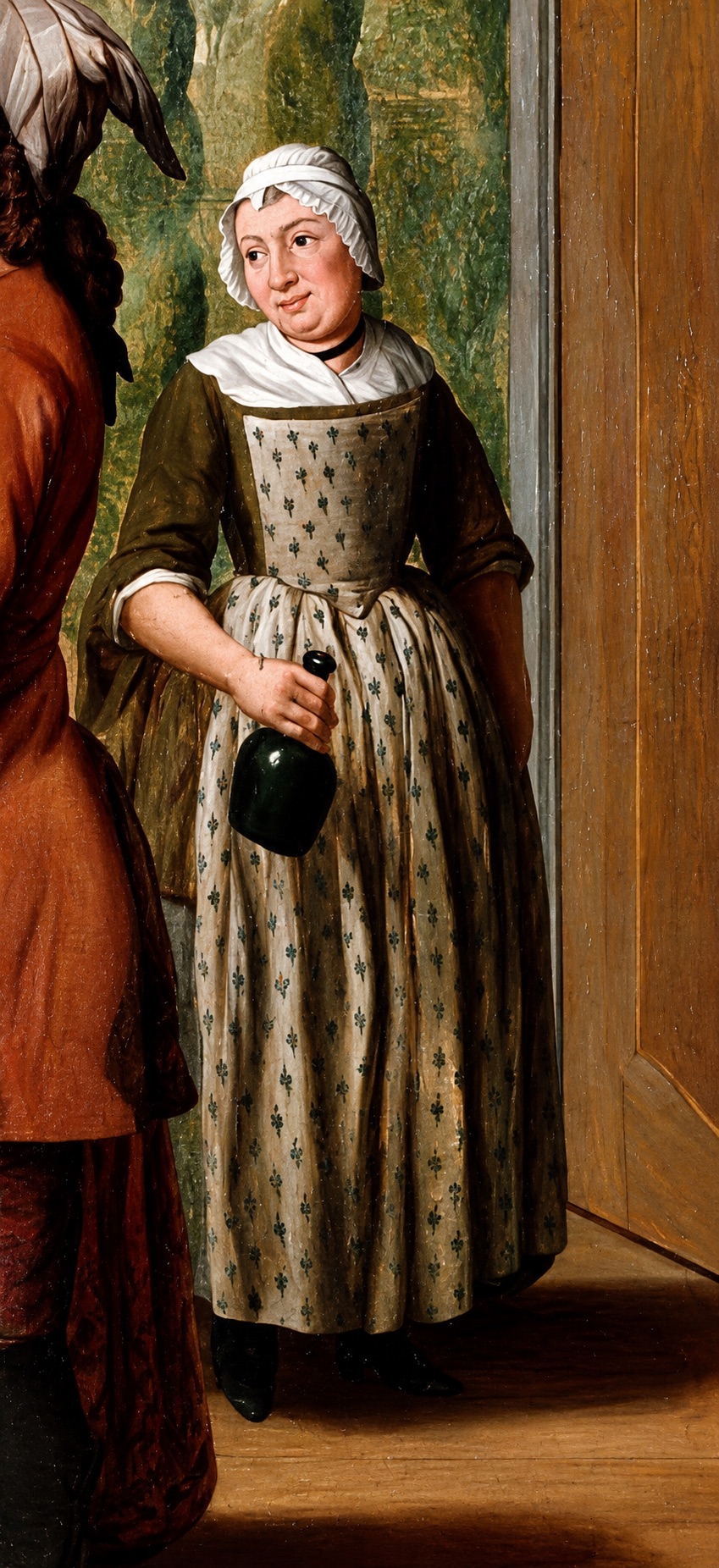
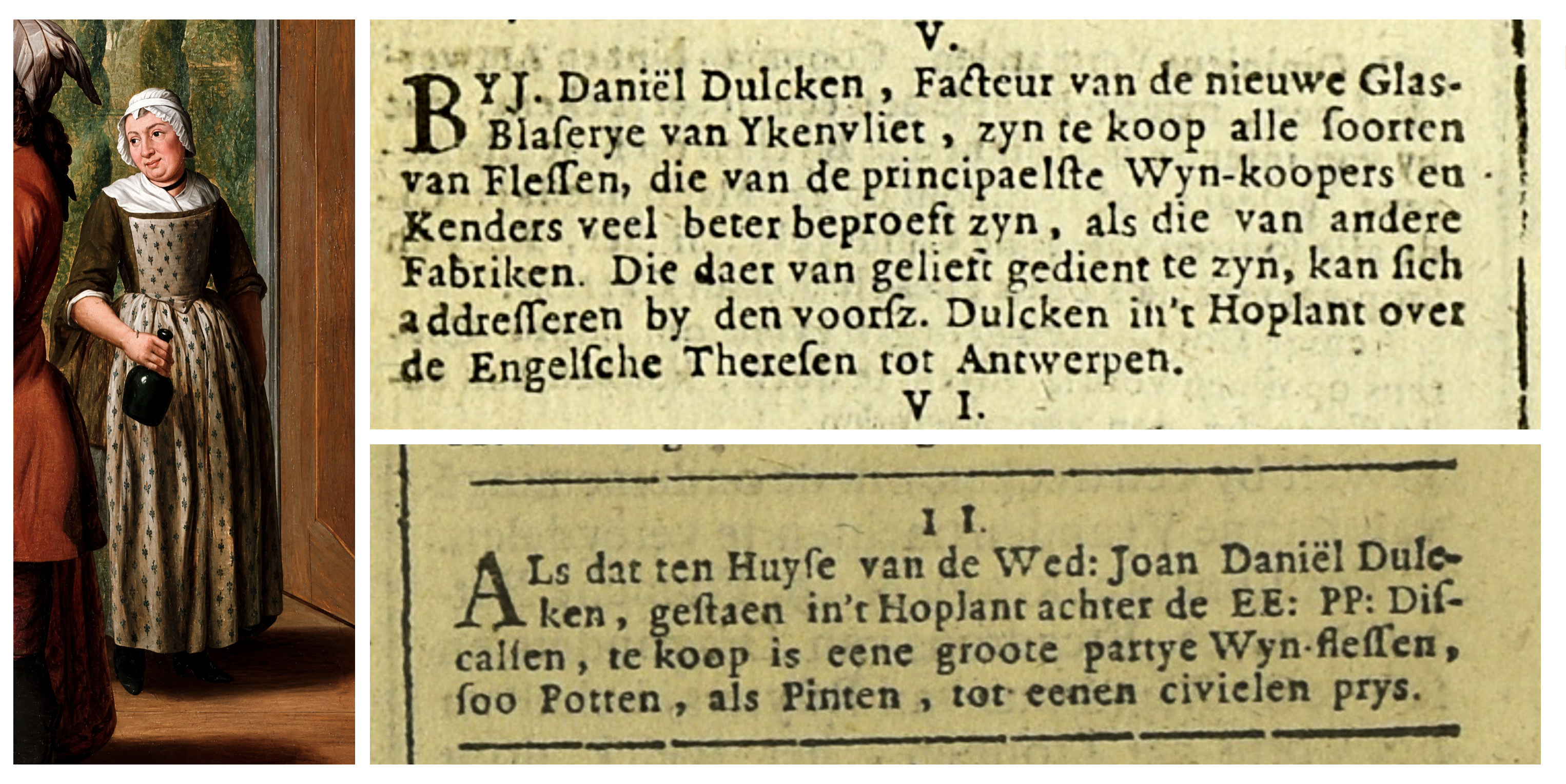
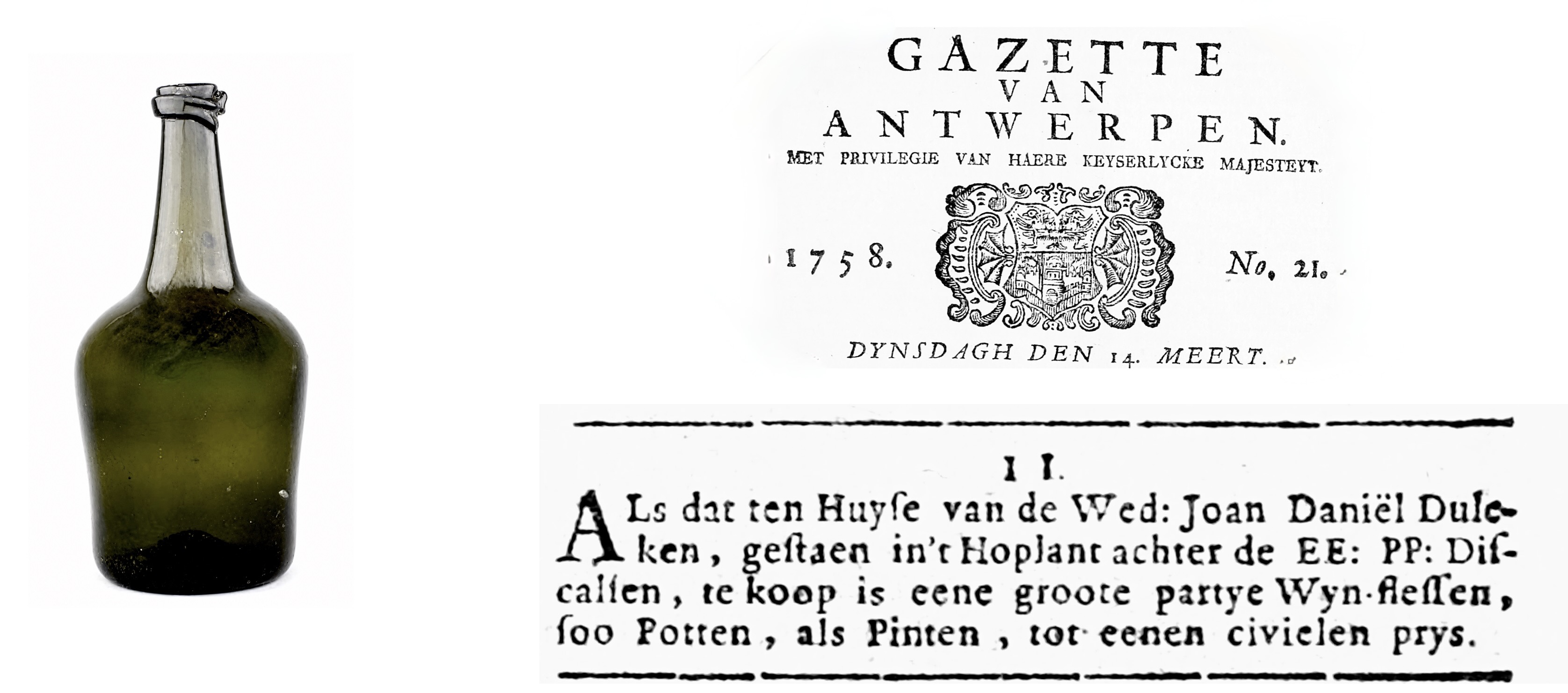
Susanne sold glassware for a glassworks in ( Advertentie 5 Meert 1756 & 14 Meert 1758 )
V. By J. Daniël Dulcken, Facteur van de nieuwe Glas- Blaserye van Ykenvliet, zyn te koop alle soorten van Flessen, die van de principaelste Wyn-koopers en Kenders veel beter beproeft zyn, als die van andere Fabriken. Die daer van gelieft gedient te zyn, kan sich addresseren by den voorsz. Dulcken in’t Hoplant over de Engelsche Theresen tot Antwerpen.
🇬🇧
V. At [the shop of] J. Daniël Dulcken, agent of the new glassworks of Ykenvliet, all kinds of bottles are for sale, which have been tested and found to be much better by the most prominent wine merchants and connoisseurs than those from other factories. Anyone who wishes to be served with these can apply to the aforementioned Dulcken in the Hopland [street], opposite the English Teresians in Antwerp.
I I. Als dat ten Huyse van de Wed: Joan Daniël Dule- ken, gestaen in't Hopland achter de EE: PP: Dis- calsen, te koop is eene groote partye Wyn-flessen, soo Potten, als Pinten, tot eenen civielen prys.
Betekenis-notitie: "EE: PP: Discalsen" staat voor de "Eerwaarde Paters Discalsen" (ongeschoeide karmelieten).
🇬🇧
I I. At the house of the widow of Joan Daniël Duleken, located in the Hopland [street] behind the Reverend Fathers Discalced Carmelites, a large quantity of wine bottles is for sale—both quarts and pints—at a reasonable price.
Explanatory note: “EE: PP: Discalsen” stands for the “Venerable Fathers of Discalsen” (Discalced Carmelites).
🇬🇧
YKENVLIET 1756 to 1789
Eikevliet is a hamlet in the Belgian province of Antwerp, in the south-east of Hingene (a borough of Bornem), which owes its origins to its location on a bend in the Vliet, which forms the boundary with Ruisbroek (Puurs). A small, roughly triangular settlement, surrounded by countryside; to the west lies ‘Het Moer’, a wooded, marshy area with a drainage network and straight roads, dating from the second half of the 17th century, presumably from 1674 onwards.
First mentioned in 1254 in connection with the embankment works at ‘Eikerbroek’. Eikevliet belonged administratively to Hingene and ecclesiastically to Puurs. The Vliet, a tributary of the Rupel, had long been important due to its navigability as far as Puurs, which was further enhanced in the 19th century by the straightening of several bends. Eikevliet was the first landing stage from the Rupel. As a result, from the 18th century onwards, but particularly in the 19th century, a bustling economic activity developed; for instance, there was even a glassworks from 1756 to 1789. The ‘Slijkhoek’ served as a quay for the numerous breweries, soap works and salt works.
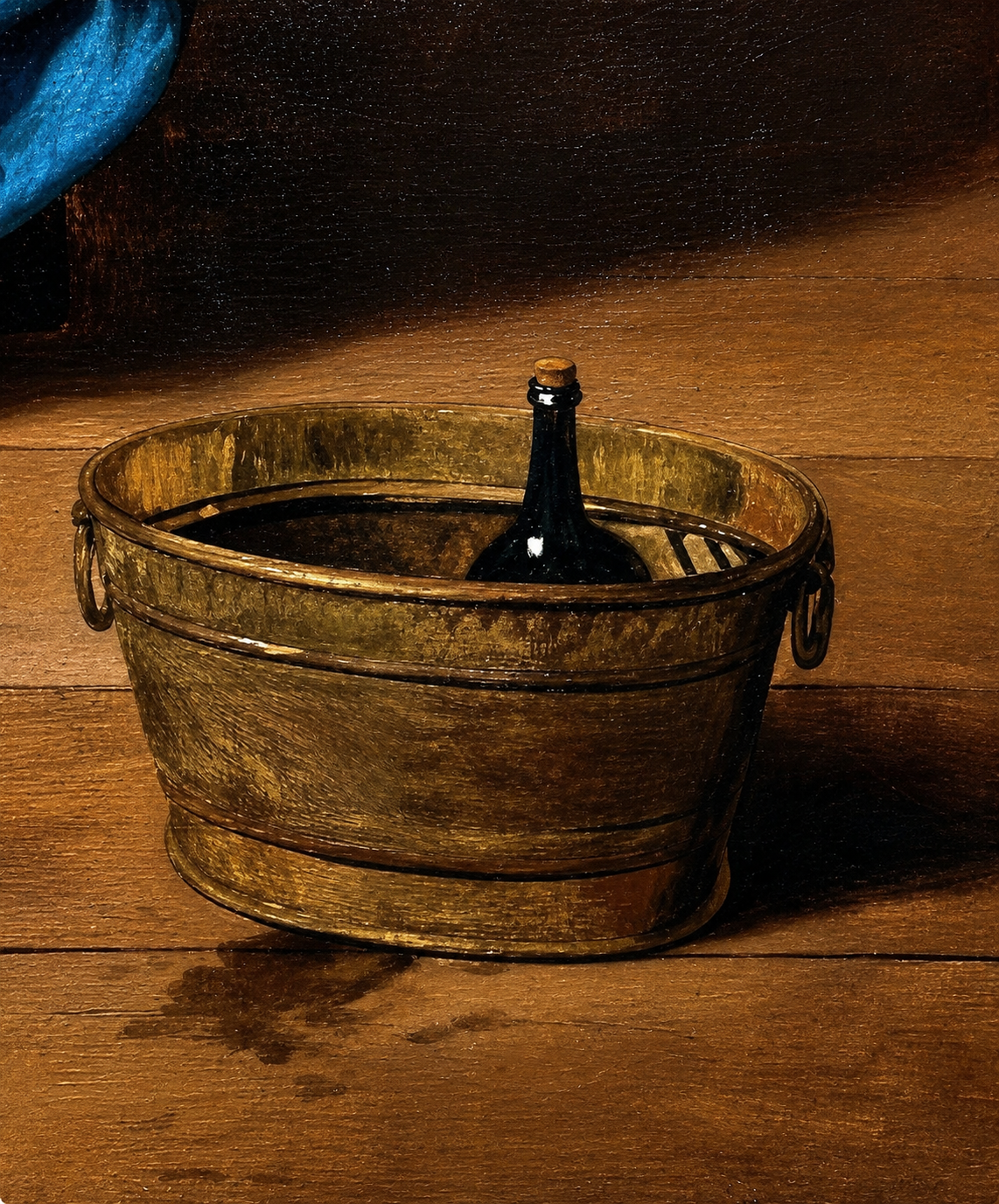
The figure with the rolled-up scroll
A comparison with a second musical scene by Horemans reveals a striking similarity.
In both paintings, the central figure is virtually identical, holding a rolled-up scroll aloft above the group.
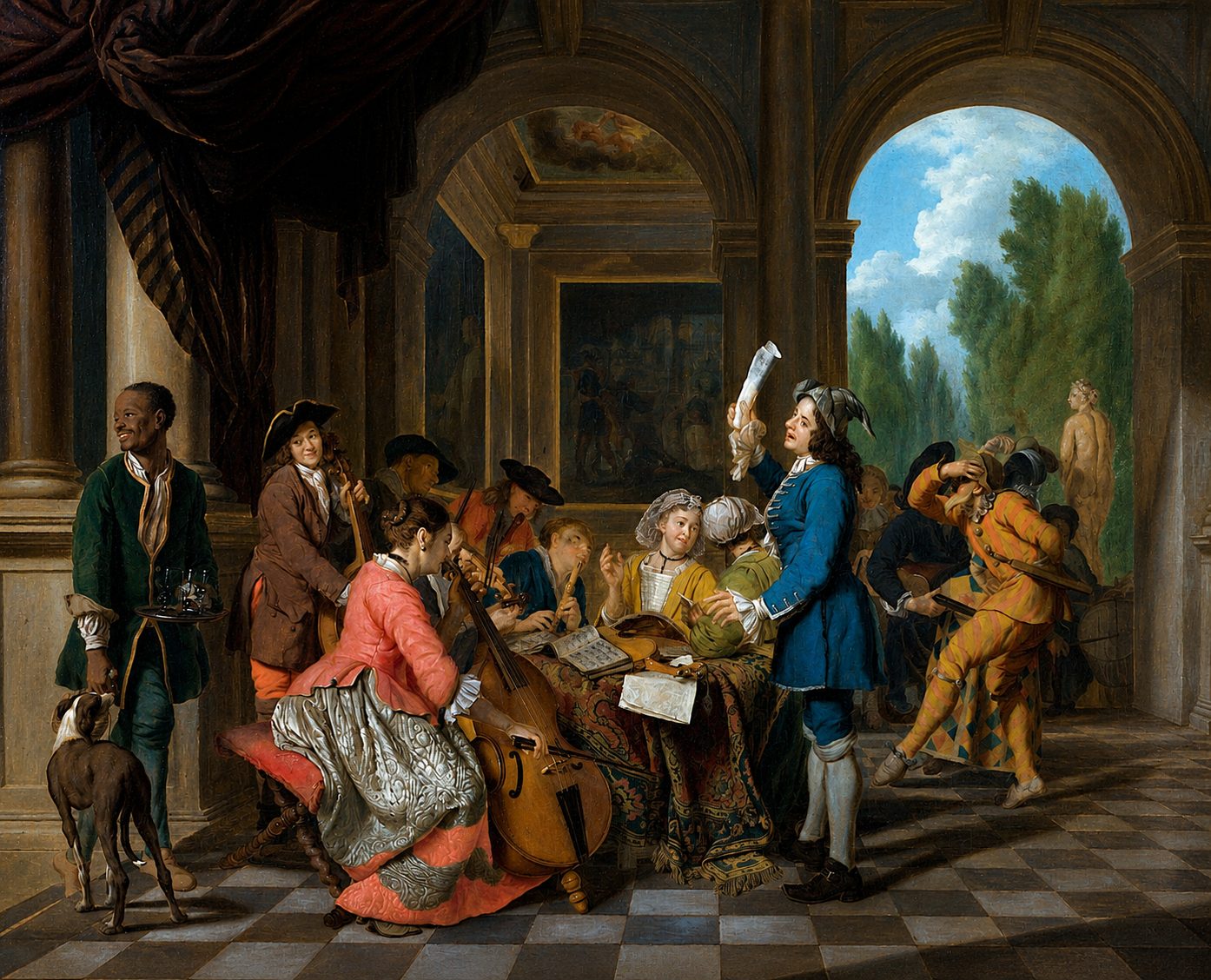
J Horemans 1764 !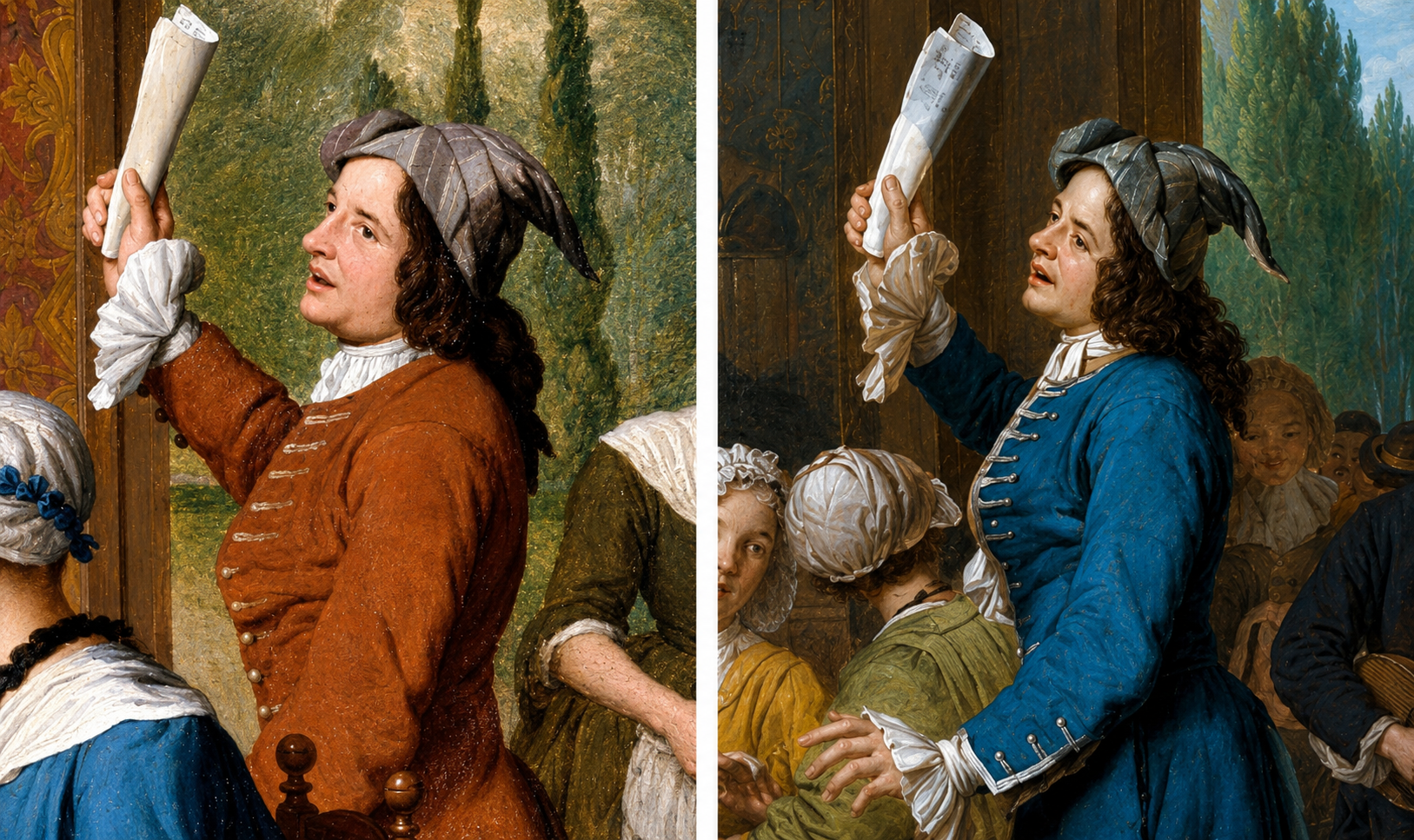
The similarities are striking:
• the same pose;
• similar clothing;
• a white neckerchief;
• a casual cap for indoor wear;
• a prominent position in the composition.
•
This repetition suggests that Horemans deliberately employed this motif.
The role may have various meanings:
• a new musical composition;
• a concert programme;
• an official announcement;
In that case, the scroll being held aloft could refer to an official announcement, a farewell or a festive transition to a new phase in the family’s history.
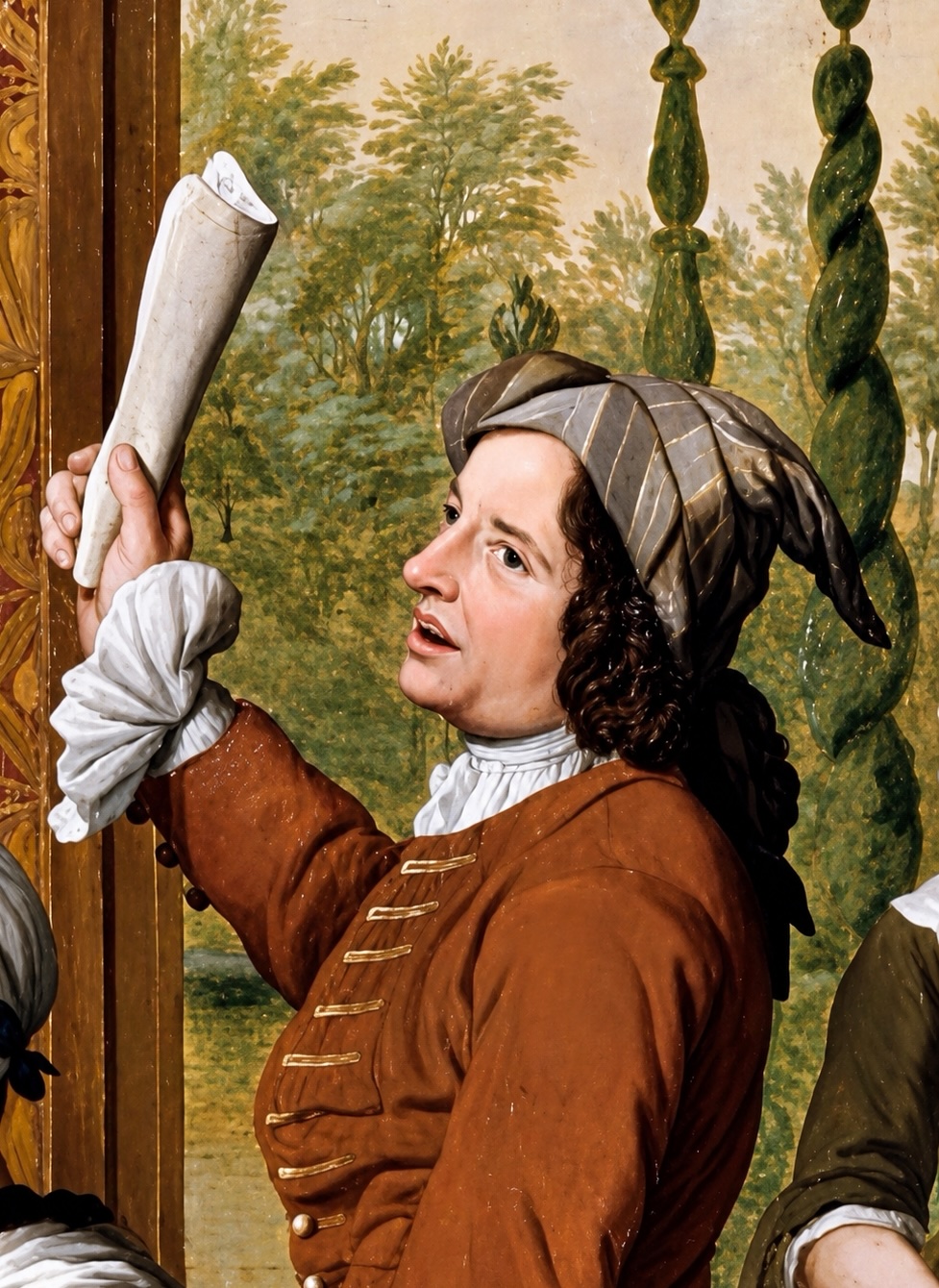
Man or woman?
The refined facial features have led to the figure sometimes being interpreted as a woman.
However, a comparison with the second painting suggests it is more likely to be a man.
The clothing consists of a justaucorps, a men’s neckerchief, knee-length trousers and stockings, all in keeping with mid-eighteenth-century men’s fashion.
The cloth cap worn indoors was also customary for gentlemen at the time.
It therefore seems less likely that the figure is a woman.
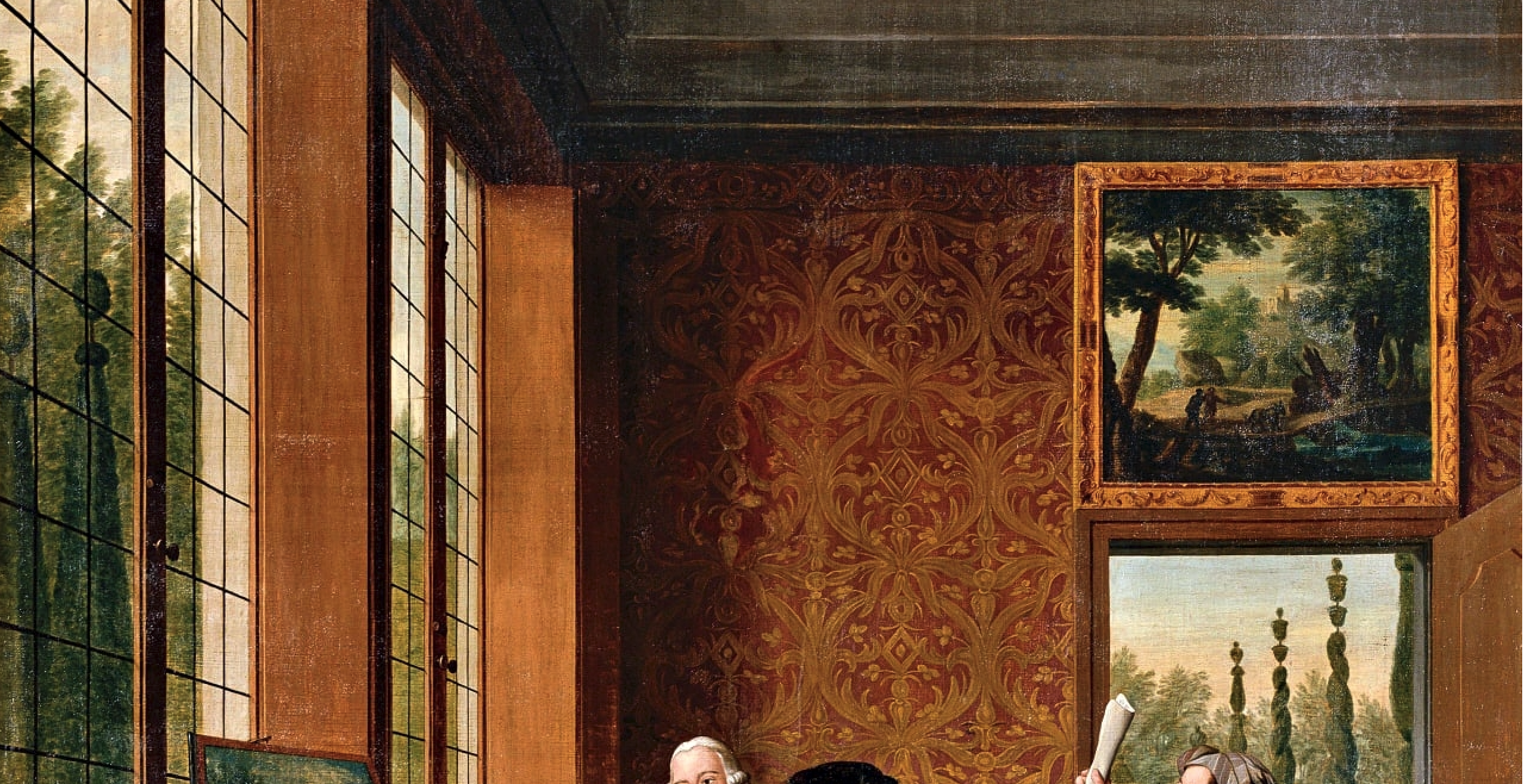
The Overdoor Painting in the Antwerp Bourgeois Home
The overdoor painting, traditionally known by the French term dessus-de-porte, was the ultimate status symbol of eighteenth-century Antwerp interior architecture. This was not a loose canvas hanging casually from a wire; it was a fundamental component of the room itself. By replacing the blank, dark void above interior doors, it compelled the gaze of any visitor to wander upward.
For the Antwerp elite, this architectural feature served a dual purpose. On one hand, it was pure aesthetics: it visually heightened the doorway, lending a palatial, regal allure to the space. On the other hand, it broke the claustrophobia of dense urban townhouses. Right above the threshold, it opened up a sprawling, sun-drenched woodland with a panoramic view toward a distant, mythical hill crowned with classical ruins.
The Fault Line of Time
What makes these overdoor paintings so fascinating in practice is the collision of eras. When Horemans painted a contemporary bourgeois interior in 1764, he captured the height of mid-eighteenth-century fashion: the powdered wigs, the stiff corsets, and the latest musical instruments. Yet, the painting above the door resolutely looked backward.
The masters who pioneered these specific landscapes—seventeenth-century titans like David Vinckboons or Gaspard Dughet—had been dead for decades, sometimes well over a century. Nonetheless, their presence in the Antwerp salons remained palpable. Wealthy patricians flaunted original seventeenth-century canvases, custom-fitted by joiners into the doorframes. Those with slightly modest means turned to the bustling Antwerp art market to purchase contemporary eighteenth-century copies or 'pastichios'—brand-new paintings deliberately executed in the nostalgic, warm style of the Flemish and Dutch Golden Age.
A Silent Message Above the Threshold
The landscape above the door was far more than mere decoration; it whispered a subtle message to everyone crossing the threshold. While the room below buzzed with transience—the fleeting notes of the cello, the pouring of wine, the latest gossip—the landscape above symbolized the eternal. The rugged rocks, the ancient trees, and the Biblical or mythological figures (such as the Disciples of Emmaus walking across the bridge) reminded the inhabitants of enduring moral virtues and the grandeur of creation.
Furthermore, it was an explicit declaration of good taste and historical awareness. The homeowner was effectively saying: “I live in the present, but my roots and my capital are anchored in the rich lineage of our art history.”
As the guests prepared to leave the salon at the end of the evening, they would cast one final glance upward. Under the warm flicker of candlelight, the painted trees above the door seemed to rustle gently in an imaginary breeze. The overdoor piece was the perfect Antwerp paradox: an immovable piece of wood and canvas that allowed an entire room to breathe.
Cultural-Historical Analysis of Topiary in 18th-Century Garden Architecture
In 18th-century Southern Netherlandish painting, particularly in the works of Jan Josef Horemans, the depiction of outdoor spaces reflects the dominant architectural and societal trends of the elite. The meticulously pruned trees visible in the background offer a direct view into the formal garden art of the period.
1. Typology and Horticultural Technique
The trees in the background are the result of topiary (formal clipping). This is the horticultural practice of training perennial, evergreen woody plants into clear geometric or figurative shapes.
Plant Species: In 18th-century urban courtyards and country estates around Antwerp, gardeners almost exclusively used Yew (Taxus baccata) and Boxwood (Buxus sempervirens). These species are ideal for precision work due to their slow growth rate and dense foliage.
Geometric Profiles: The depicted trees show a succession of horizontal discs tapering into a conical or pyramidal shape. Achieving this required the use of wooden or iron frames, alongside decades of consistent, highly skilled pruning to maintain sharp lines.
2. Socio-Economic Context
Owning a formal garden featuring complex topiary was strictly reserved for the wealthy bourgeoisie and the nobility during the first half of the 18th century.
Status Symbol: Because yew and boxwood grow very slowly, mature topiary trees represented a massive capital investment. They served as a direct demonstration of generational wealth.
Labor Intensity: Maintaining these rigid shapes required permanent, specialized staff (master gardeners). Displaying such flawless garden elements was a clear indicator of economic power and disposable income.
3. Philosophical Background: Domestication of Nature
The formal garden, heavily influenced by the French Baroque style (jardin à la française), was rooted in the philosophy of Rationalism and the early Enlightenment.
Reason versus Chaos: Nature in its wild, untamed state was viewed as chaotic, unpredictable, and raw. By forcing trees into strict geometric shapes, humanity demonstrated its intellectual and technological superiority over the natural world.
Architectural Extension: The garden was treated as an outdoor extension of the house. The clipped trees functioned as "green walls" and "living statues," extending the symmetry and axes of the interior architecture into the open air.
4. The Visual Paradox in Horemans' Composition
Within the art-historical analysis of this specific scene, a deliberate thematic contrast is evident:
The overdoor painting (the framed artwork above the doorway) depicts a landscape in the tradition of 17th-century Dutch and Flemish masters: wild, asymmetrical, and organic.
The reality outside the door shows the exact opposite: a strictly cultivated, highly artificial outdoor space.
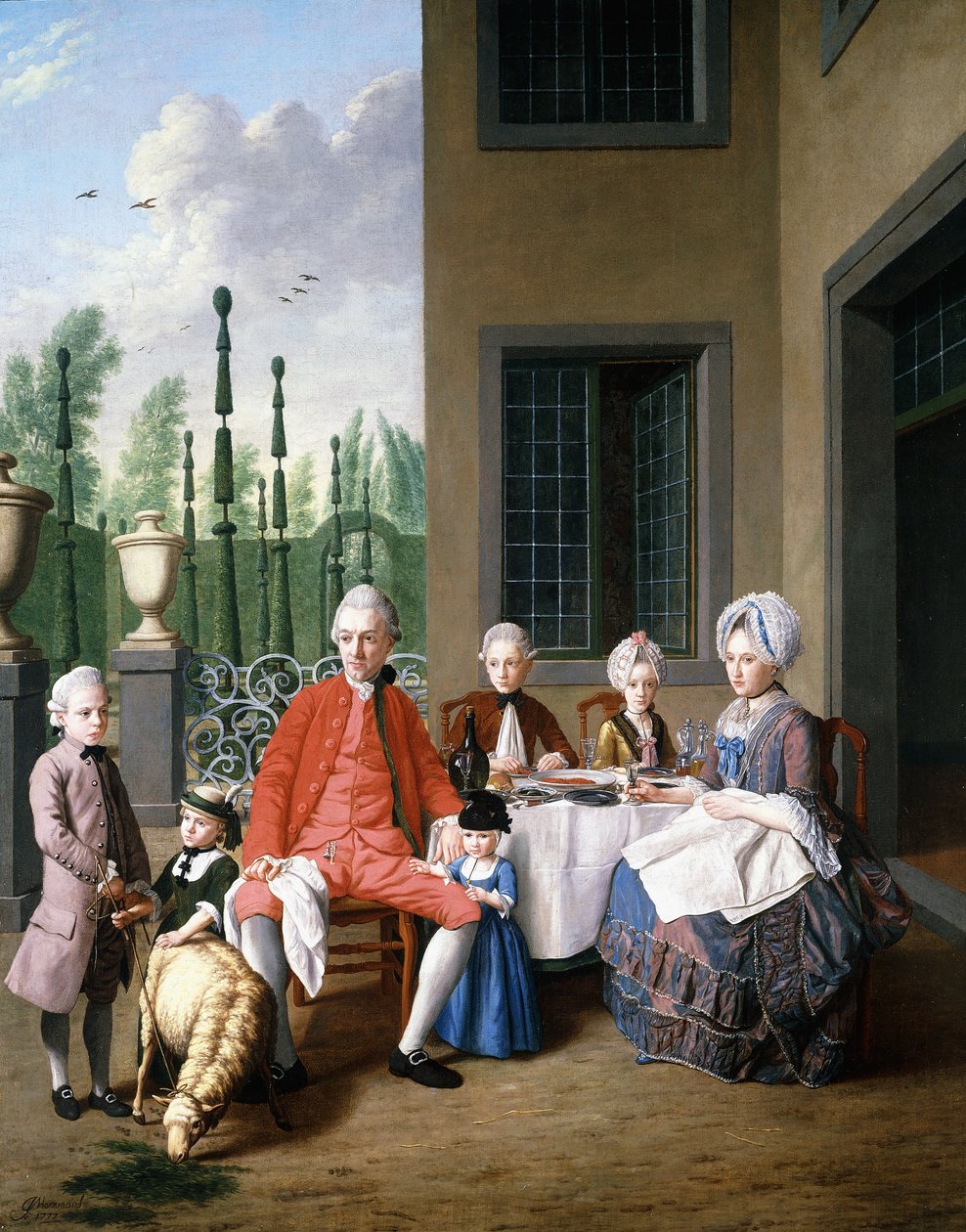
Jan Josef Horemans II
Group portrait of the van den Bosch family, dining by a house, a topiary garden beyond
The linen mark: In the centre-right of the painting, on the napkin of the seated lady, the linen mark ‘VDB.12’ is written. This confirms the surname ‘Van den Bosch’ (VDB) and suggests that this was a wealthy middle-class family who had their own precious silverware and linen marked.
The setting: The family is depicted dining outdoors at a stately house, with a neatly trimmed topiary garden in the background. This suggests that they were well-to-do burghers or patricians with their own country estate.
No aristocratic connection: Although there is a well-known Dutch noble family named Van den Bosch (to which the later Governor-General Johannes Count van den Bosch belonged), there is no historical evidence that this painting depicts this specific branch of the family. Horemans worked mainly in Antwerp, where he painted the local bourgeoisie of the Southern Netherlands.
The Embedded Emmaus Landscape in Horemans’ Interior
Within the oeuvre of Jan Josef Horemans (I or II), the fragment shown here serves as a classic example of a painting-within-a-painting (pictura in pictura). The framed work on the wall is not merely a random background element, but one that has been carefully chosen for its historical and thematic significance.
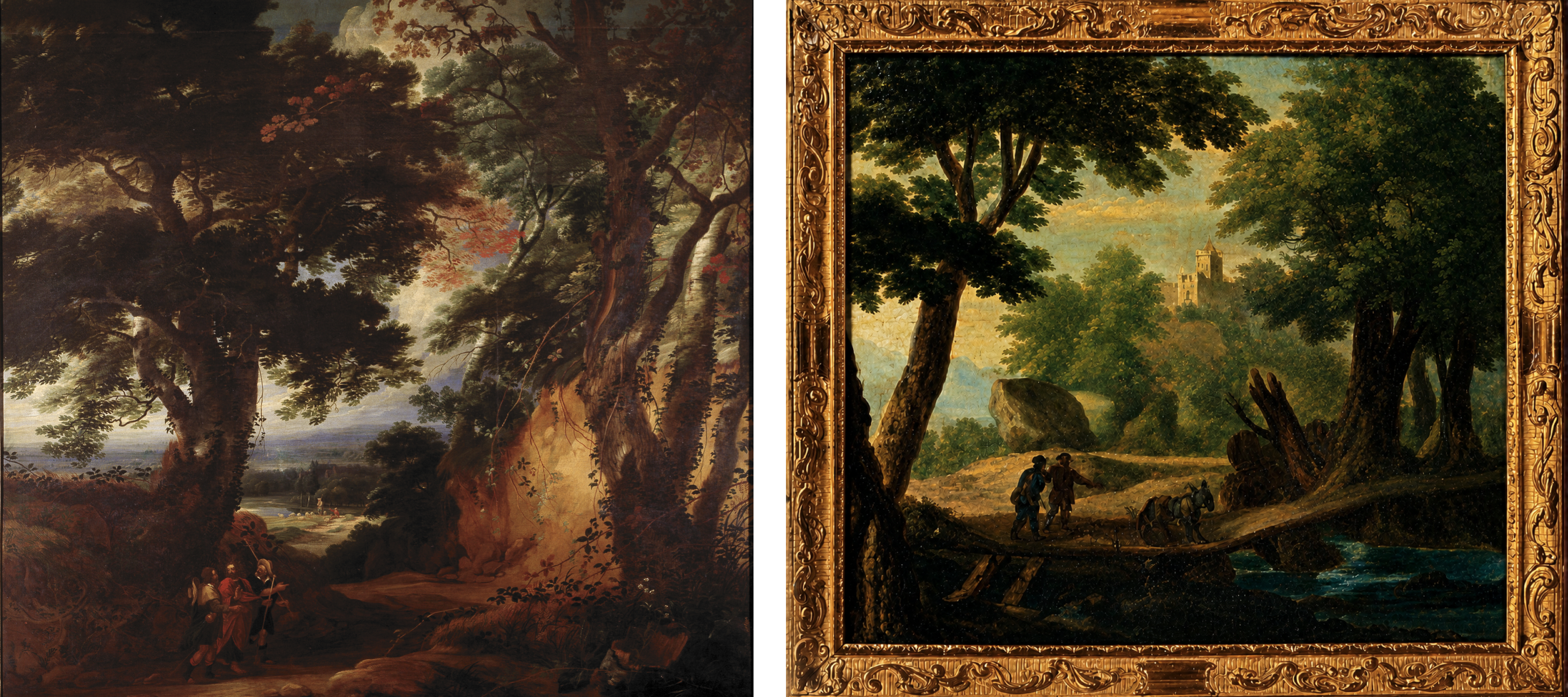
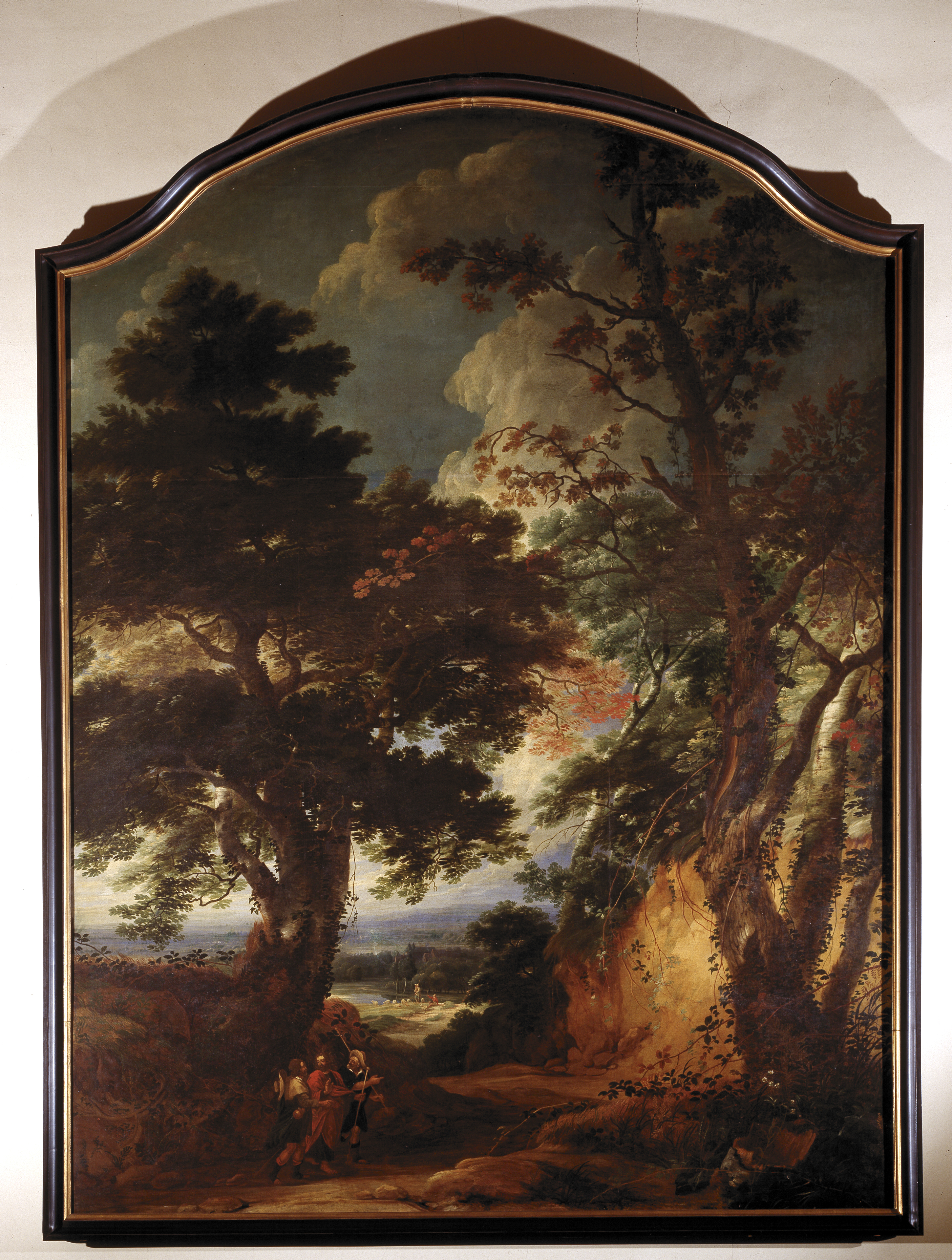
Lucas Achtschellinck
Iconographic Identification: The Travellers to Emmaus
The landscape depicted in the painting illustrates the biblical passage from the Gospel of Luke (Luke 24:13–35): The Journey to Emmaus.
Composition: Three figures are visible on the sunlit forest path. The figure on the left represents the risen Jesus Christ, travelling incognito with two disillusioned disciples.
Attributes: The pack animal (horse or donkey) and the travellers’ staffs emphasise the physical journey between Jerusalem and the village of Emmaus.
Reference to the Flemish landscape tradition
With this background detail, Horemans drew on a specific painting tradition of the Southern Netherlands. Stylistically, the landscape depicted can be directly traced back to the work of the Brussels Baroque painter Lucas Achtschellinck (1626–1699).
Probably a painting depicting the disciples on the road to Emmaus (or the journey to Emmaus)
This type of artwork was particularly popular in Flemish and Dutch painting during the 16th and 17th centuries. The composition is characteristic: a vast, wooded and hilly landscape with figures walking along a path in the foreground, often accompanied by a donkey or travellers’ luggage. In the background, a castle or fortified town is often visible, which in this type of composition symbolises the village of Emmaus.
Below you will find the corresponding Bible story and the significance of this scene.
The Biblical Story: The Walk to Emmaus
The story of the Emmaus disciples is found in the New Testament of the Bible, specifically in Luke 24:13-35.
1. Walking in Grief
The story takes place on the Sunday after the crucifixion of Jesus (Easter morning). Two followers of Jesus (one named Cleopas) are walking from Jerusalem to a village called Emmaus, about seven miles away. They are deeply heartbroken and are discussing everything that happened over the past few days—the trial, the crucifixion, and the shocking news that Jesus' tomb was found empty that morning.
2. The Unknown Traveler
While they are talking, a stranger approaches and begins walking with them. It is actually the risen Jesus, but the Bible notes that their eyes are kept from recognizing him. The stranger asks them what they are discussing so intently.
Surprised that he seems to be the only one unaware of recent events, they explain who Jesus of Nazareth was: a powerful prophet whom they hoped would redeem Israel. They also mention the confusing reports from the women who saw visions of angels claiming Jesus was alive.
3. Explaining the Scriptures
The stranger rebukes them gently for being slow of heart to believe. Then, starting with Moses and all the Prophets, he explains to them what was said in all the Scriptures concerning himself, showing that the Messiah had to suffer these things before entering his glory. As he speaks, the two men feel a strange comfort growing within them.
4. Recognition at the Breaking of Bread
As they approach Emmaus, the stranger acts as if he is going further. However, they urge him strongly, saying, "Stay with us, for it is nearly evening; the day is almost over."
He joins them at the table. When he takes the bread, gives thanks, breaks it, and begins to give it to them, their eyes are suddenly opened. They recognize him as Jesus. At that exact moment, he vanishes from their sight.
Amazed, they say to each other, "Were not our hearts burning within us while he talked with us on the road and opened the Scriptures to us?" They immediately get up, walk the seven miles back to Jerusalem in the dark, and declare to the other disciples that the Lord has truly risen.
Artistic Context
In 16th and 17th-century European art, this subject was often used as an excuse to paint a beautiful landscape. The figures on the path symbolize the human journey through life as a spiritual pilgrimage, showing that God walks alongside people even when they do not recognize Him.
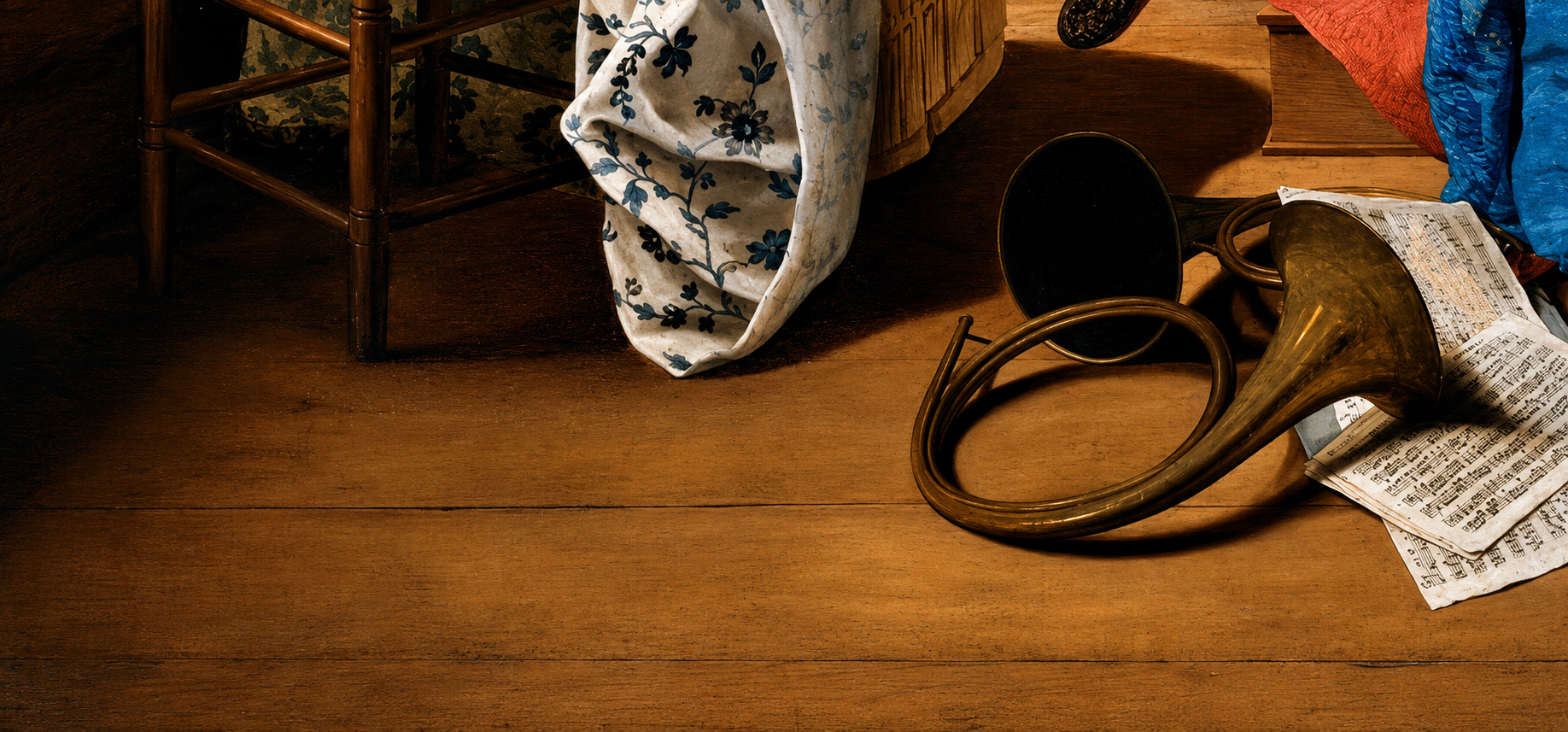
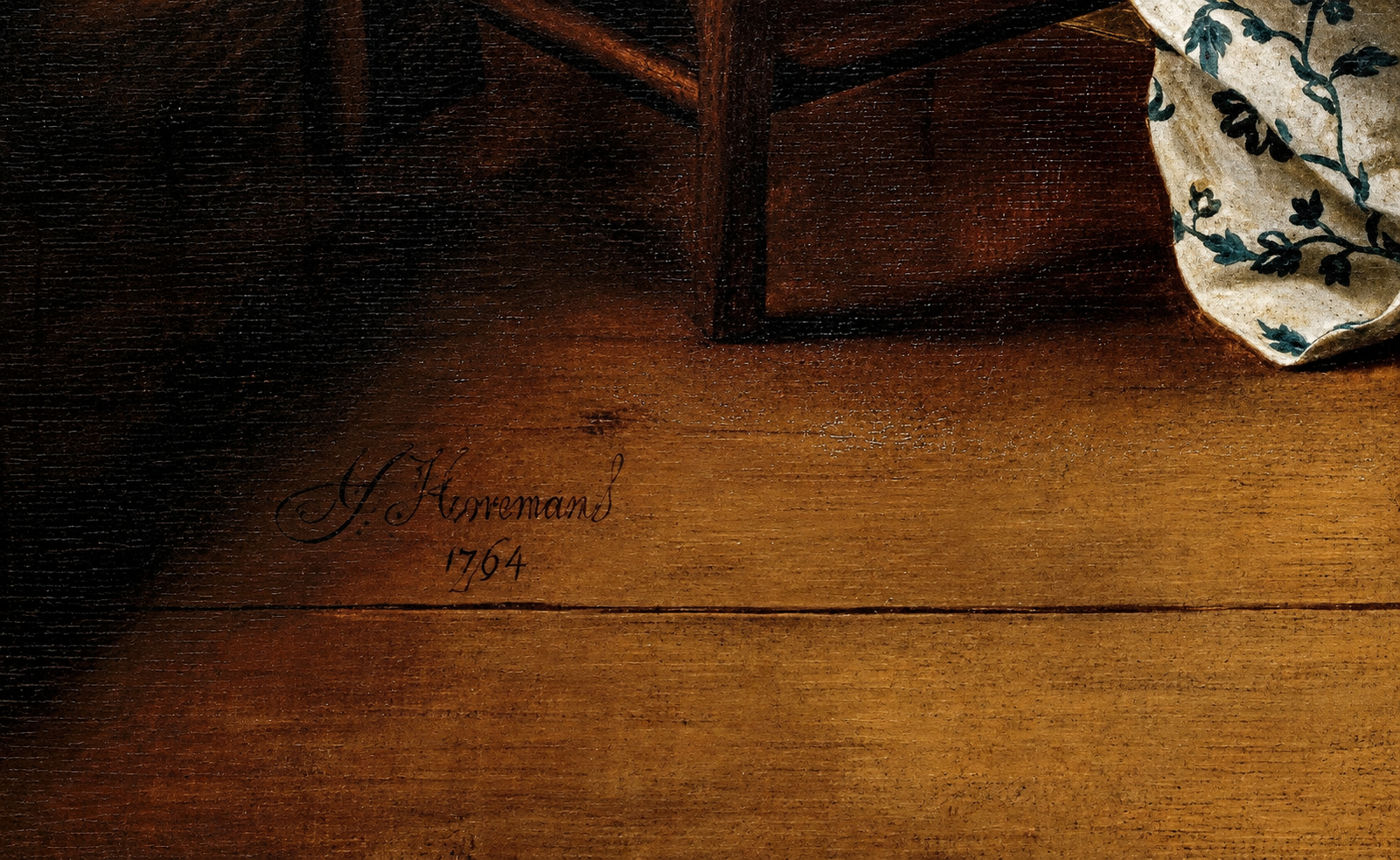
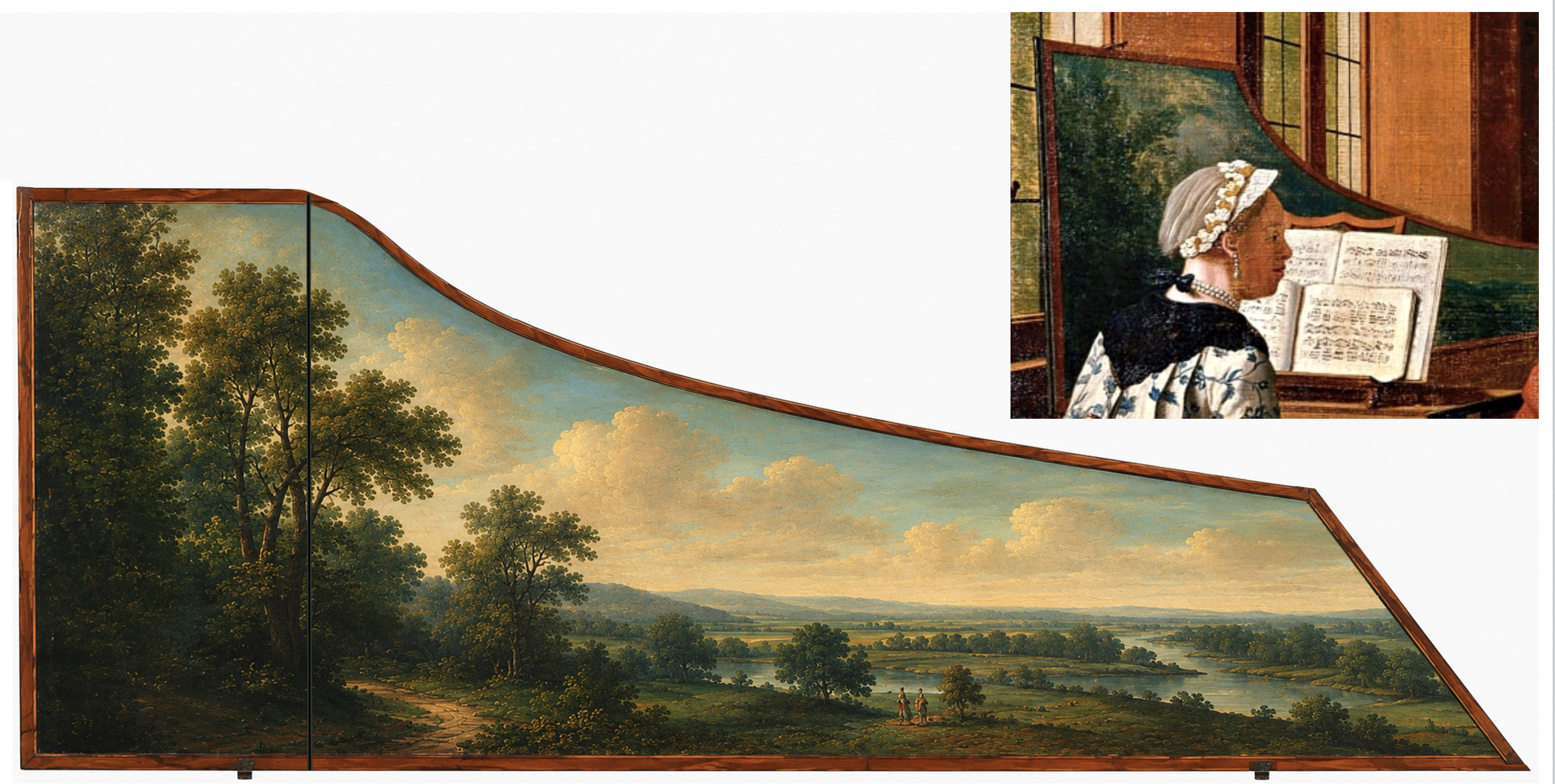
Reconstruction of a painted harpsichord lid based on the painting by J. Horemans
J. Horemans 1764
By subtly painting his signature into the perspective of the wooden floorboards, right beside the carelessly discarded natural horns and sheet music, the artist seamlessly integrates his name into the still life and intertwines himself with the deeper symbolism of the vanitas motif.
The Dulcken family and the Protestant Church in Brussels
VIDEO
signed and dated lower left: J Horemans 1764 on the floor