 Foundation Musick's Monument
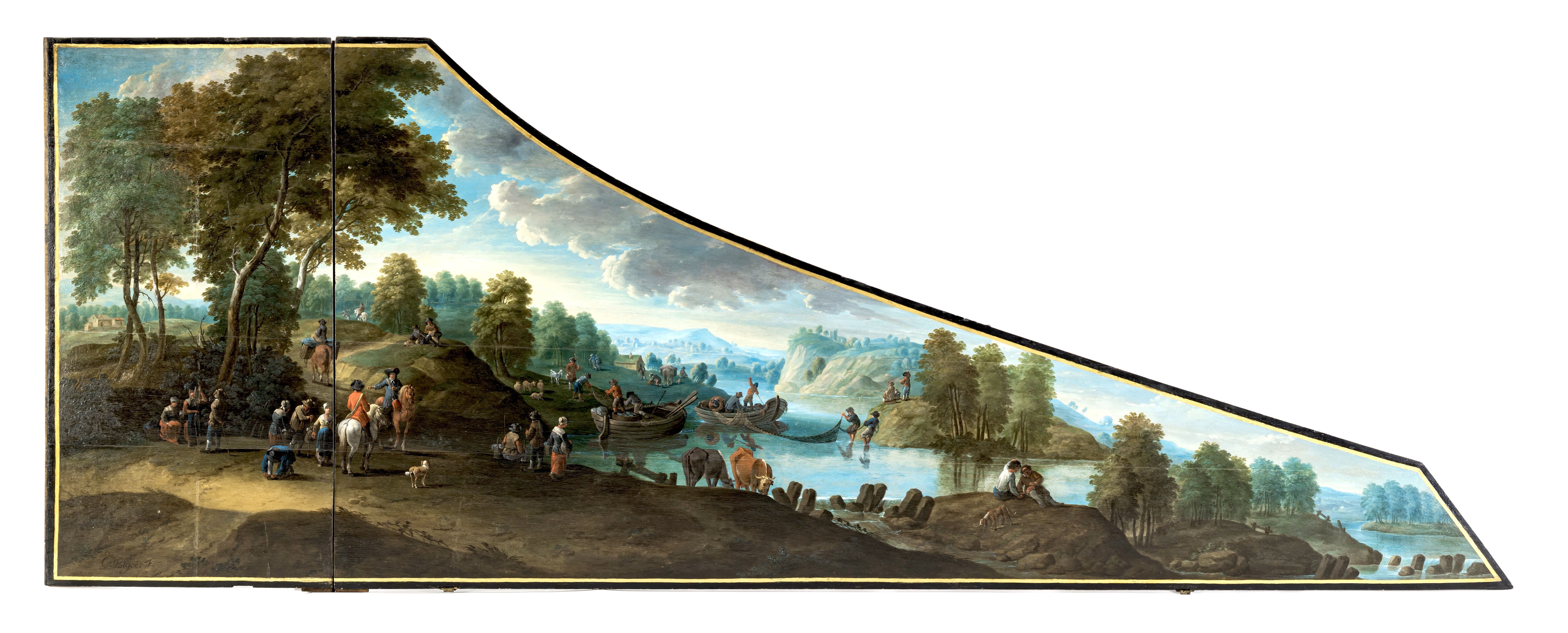
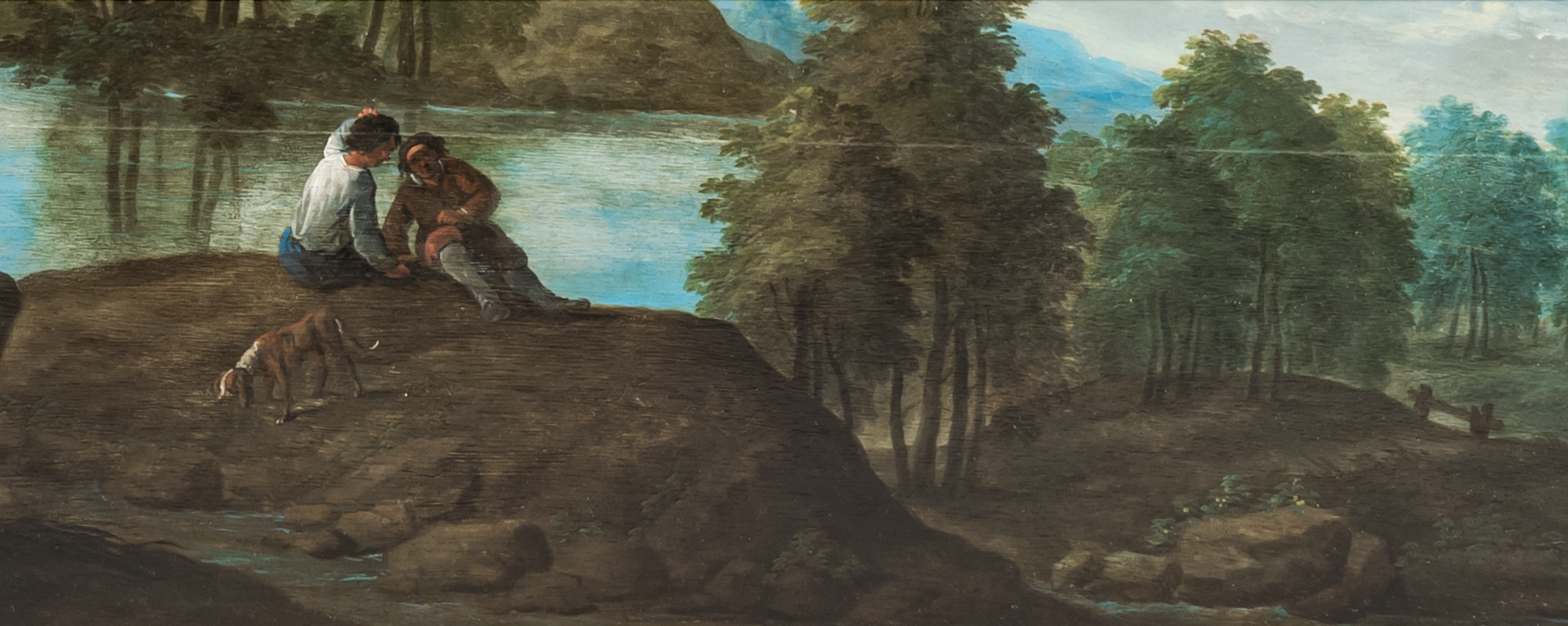
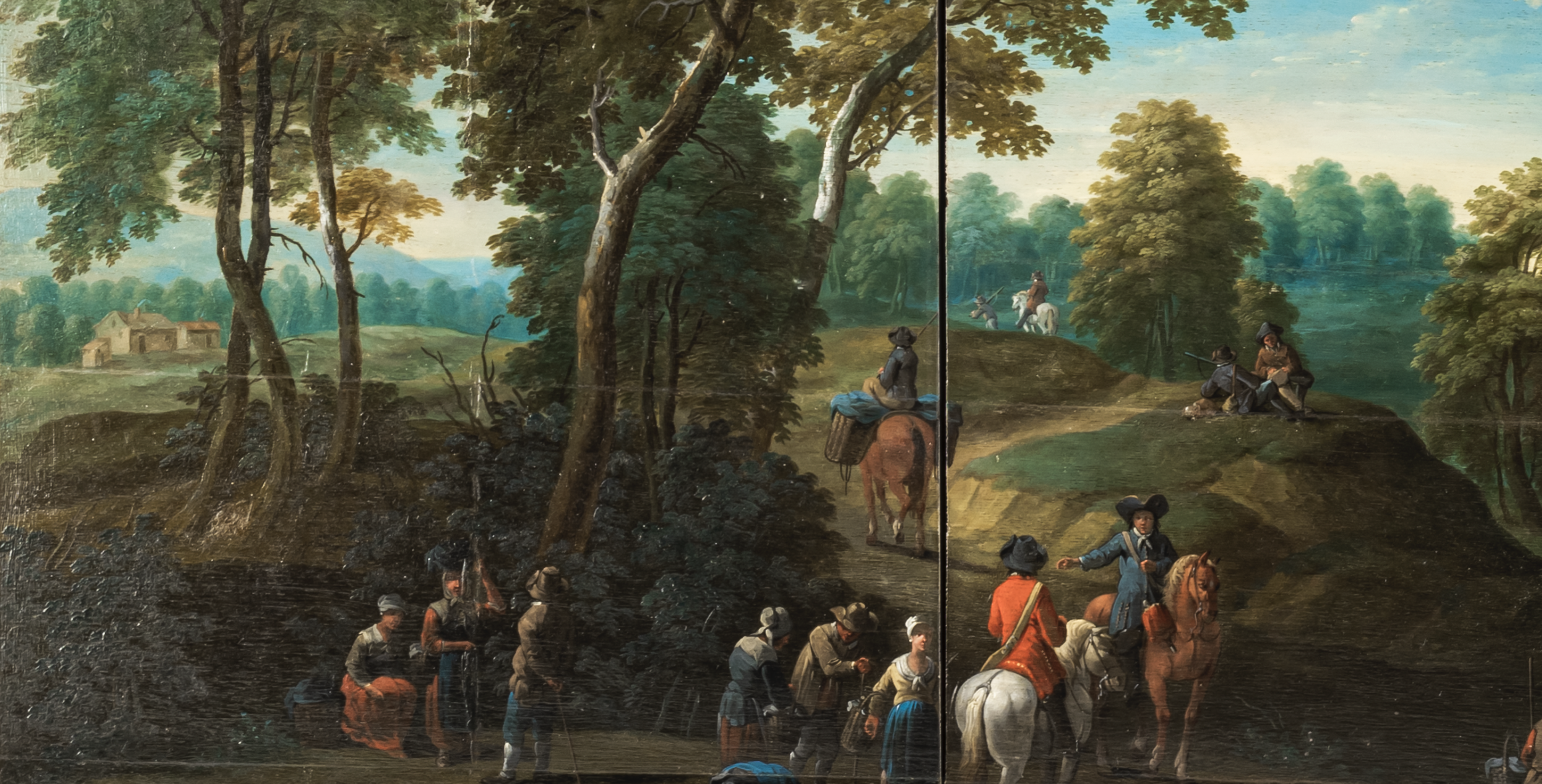
MIM – Brussels: Johannes Daniel Dulcken harpsichord with painting by Carolus Bigée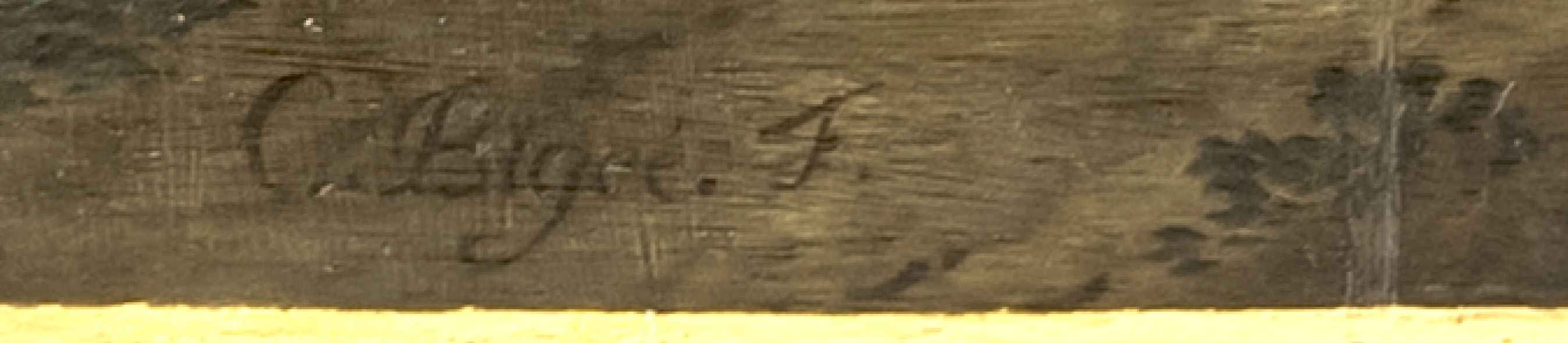
Inspired by Herman Saftleven? See Saftleven's paintings.
When we think of the Rhine in Germany or the Netherlands today, we often picture a wide, tranquil river. However, the stretch between Bingen and Koblenz – the so-called Upper Middle Rhine Valley, where Sankt Goar, Rheinfels Castle, and the Loreley are located – is world-famous precisely for its extremely steep, vertical cliff faces. The Loreley rock, for instance, rises nearly 130 meters sheer out of the water. This immense contrast in elevation is exactly what so fascinated Herman Saftleven in 1651 and what he captured (quite theatrically and with heightened drama) in his drawings. Bigée adopted this dramatic, seventeenth-century style
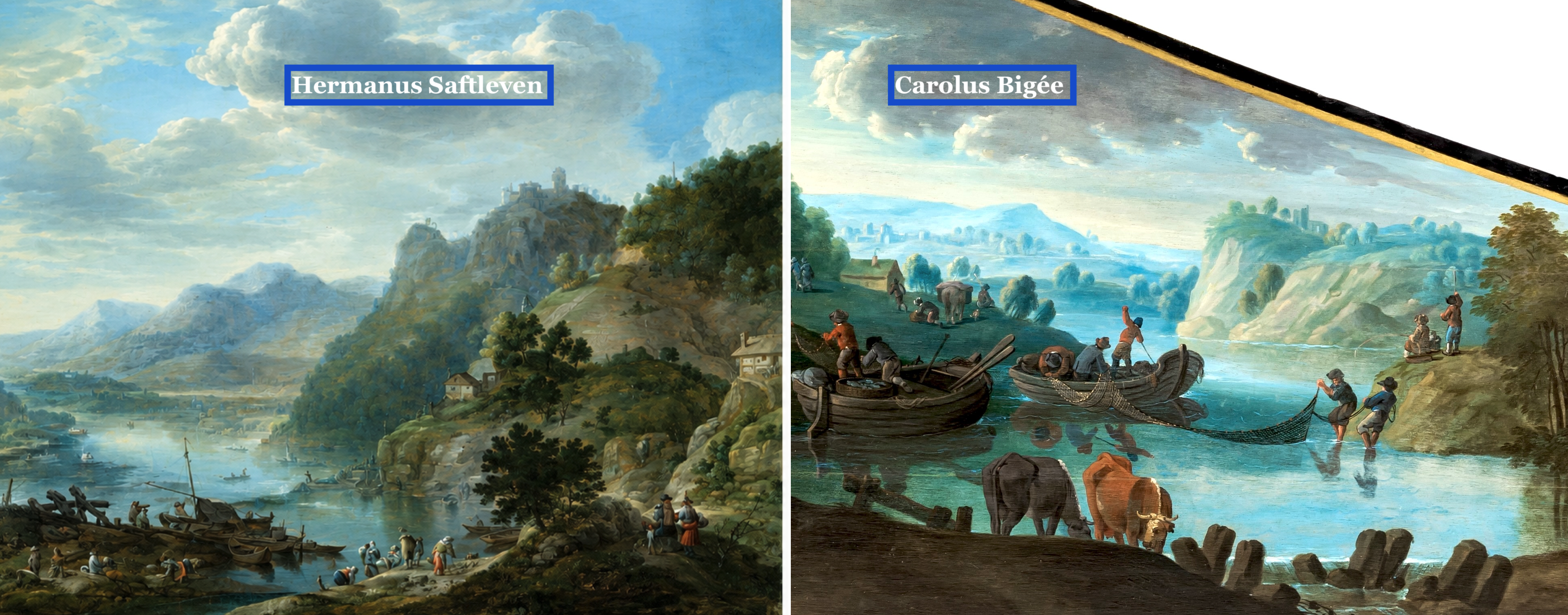
Herman Saftleven/Carolus Bigée
II
2. An Artistic Exploration After the Peace of Westphalia
In the year 1651, shortly after the signing of the Peace of Westphalia, the Utrecht artist Herman Saftleven (1609–1685) set out on a grand journey. The opening of borders following the Eighty Years' War led to a true migration of Dutch artists toward the German hinterland. Saftleven's journey took him deep along the Rhine, from the familiar Republic to Bingen am Rhein. The monumental, mountainous river landscape with its steep vineyards and proud castles must have made an indelible impression on him.
Armed with paper and charcoal, he meticulously recorded this Rheinfahrt. Along the way, he sketched iconic locations such as Doorwerth Castle, Hoog-Elten, Kleve, and Boetzelaer Castle. Further downstream followed Bonn, the Siebengebirge, Rolandseck, Linz am Rhein, Ehrenbreitstein near Koblenz, and the legendary Loreley. Finally, his journey ended at the impressive Mäuseturm on a small island in the Rhine near Bingen. A monumental painting from 1653, now in the collection of Schloss Weißenstein in Pommersfelden, shows a telling scene in the foreground: an artist accompanied by a boy carrying a portfolio. This is an unmistakable visual signature of Saftleven's own presence in the region, presumably accompanied by his then fourteen-year-old son Dirck.
3. The Atlas Van der Hem and Vondel's Panegyric
He presumably acquired the 37 undated Rhine prospects directly from Saftleven's studio for his renowned Atlas Blaeu-Van der Hem – a collection that today stands as a premier treasure of the Österreichische Nationalbibliothek in Vienna. In seventeenth-century society, such a documented Rhine journey was considered the ultimate form of mental escapism: in an era when travel was slow, expensive, and perilous, these pages provided a "virtual adventure."
The immense contemporary appreciation for these vivid sheets was aptly captured around 1660 by the 'prince of poets', Joost van den Vondel (1587–1679). In his panegyric On the Art-Book of Herman Zachtleven, Vondel describes how a viewer, from the comfort of their own room, could embark on a majestic, imaginary voyage. Whoever opened these "art papers" traveled in spirit out of the cathedral city of Utrecht and sailed up the Rhine:
“Hy kan stil den Ryn opstreven, Van out Uitrecht, en den Dom; Tusschen d’oevers van de stroomen,Tusschen wynbergh, bosch, en boomen, Zich verlustigen alom...”
Op het Kunstboeck van Herman Zachtleven, vermaert schilder en tekenaer
Lust het iemant Zacht te leven,
Lucht te scheppen naer zyn’ wil,
Die blyf t’huis, gerust en stil:
Hy kan stil den Ryn opstreven,
Van out Uitrecht, en den Dom;
Tusschen d’oevers van de stroomen,
Tusschen wynbergh, bosch, en boomen,
Zich verlustigen alom,
Sloten, steden, en landouwen,
Kudden, vee, en dorp, en vleck,
Ackers, en gebuurte, en heck,
Bron, en waterval aenschouwen,
In zyn kamer, zoo hy maer
Opsla deze kunstpapieren,
Zoo vol levens, zoo vol zwieren,
Dat Natuur by wylen daer
Stom staet, toornigh, en verbolgen,
Over dat, en over dit,
Over zwert, en over wit,
Licht en schaduw, snel in ‘t volgen
Van haer wezen: kan de Kunst
Kan de hant van dezen trecker
My dus volgen tot den Necker?
Heeft hem Pallas met haer gunst
En genade dus bescheenen?
Zeker laet de vlugge Faem
Dan braveeren met zyn’ naem:
Laet hem dan zyn’ naem vry leenen
Van het Leven: want hier leeft
Wat hy treckt met duim en vingeren,
Los en levendigh in ‘t slingeren,
Dat de bladen leven geeft.
Wie verdriet het op dees blaeren,
Dus den Rynstroom op te vaeren?
4. Translating to the Harpsichord: Bigée and the Dulcken Connection
Nearly a century later, this Saftlevian tradition of "traveling in an armchair" received a sensational and deeply emotional reimagining in the workshops of the Dulcken family, the illustrious harpsichord makers of Antwerp. On a beautifully preserved harpsichord lid, masterfully painted and signed by Carolus Bigée (C. Bigée F.), the exact iconography of Saftleven's idealized Rhine prospects comes to life.
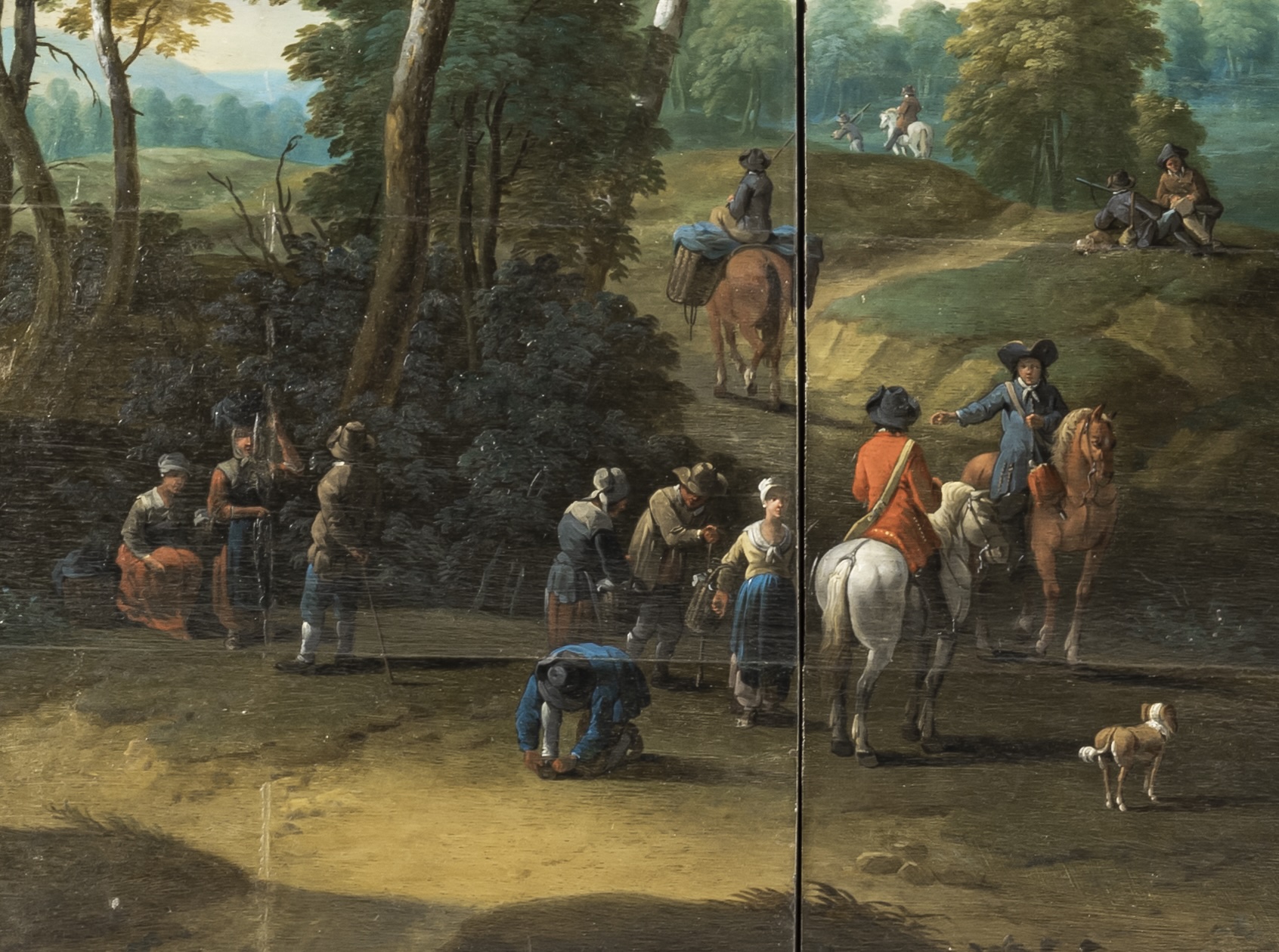
Bigée made ingenious use of the instrument's asymmetrical shape. On the wide left side, he painted a dark, monumental 'coulisse' feature with trees and staffage, from which the eye is guided diagonally to the right toward an expansive river view with winding currents, fishermen, and steep, bluish crags in the distance. Just as Vondel described, this lid offered the musician and the listener the chance to drift away to the Rhine Valley as the music played.
5. The Symbolism of the Crossing and the Raging Torrent
However, a closer inspection of the foreground in Saftleven’s composition and Bigée’s masterful adaptation reveals that this is no ordinary pastoral scene. It depicts a historical ferry crossing. Along the shoreline, a compelling logistics unfolds: travelers wait by the banks and cargo is loaded onto heavy vessels. The Rhine between Bingen and Koblenz was at that time a transport artery as spectacular as it was hazardous. Eighteenth-century travelogues speak with great awe of the terrifying rapids of the Binger Loch, the treacherous whirlpools near the Loreley, and the inevitable toll stations, such as the one at Rheinfels Castle.
To brave these wild forces, travelers were entirely dependent on local mariners and strategic ferries. The depicted crossing is thus a powerful metaphor for the journey of life itself: leaving the safety of the familiar shore to conquer untamed nature. This also aligns perfectly with the physical geography of Sankt Goar, which had been connected to the opposite bank via a crucial Rheinfähre since the Middle Ages.
6. Conclusion: A Monument of Remembrance
When Johann Daniel Dulcken commissioned Carolus Bigée decades later in the Southern Netherlands to paint a Rhine landscape on the harpsichord lid, he chose a scenery that encompassed his entire soul and history.
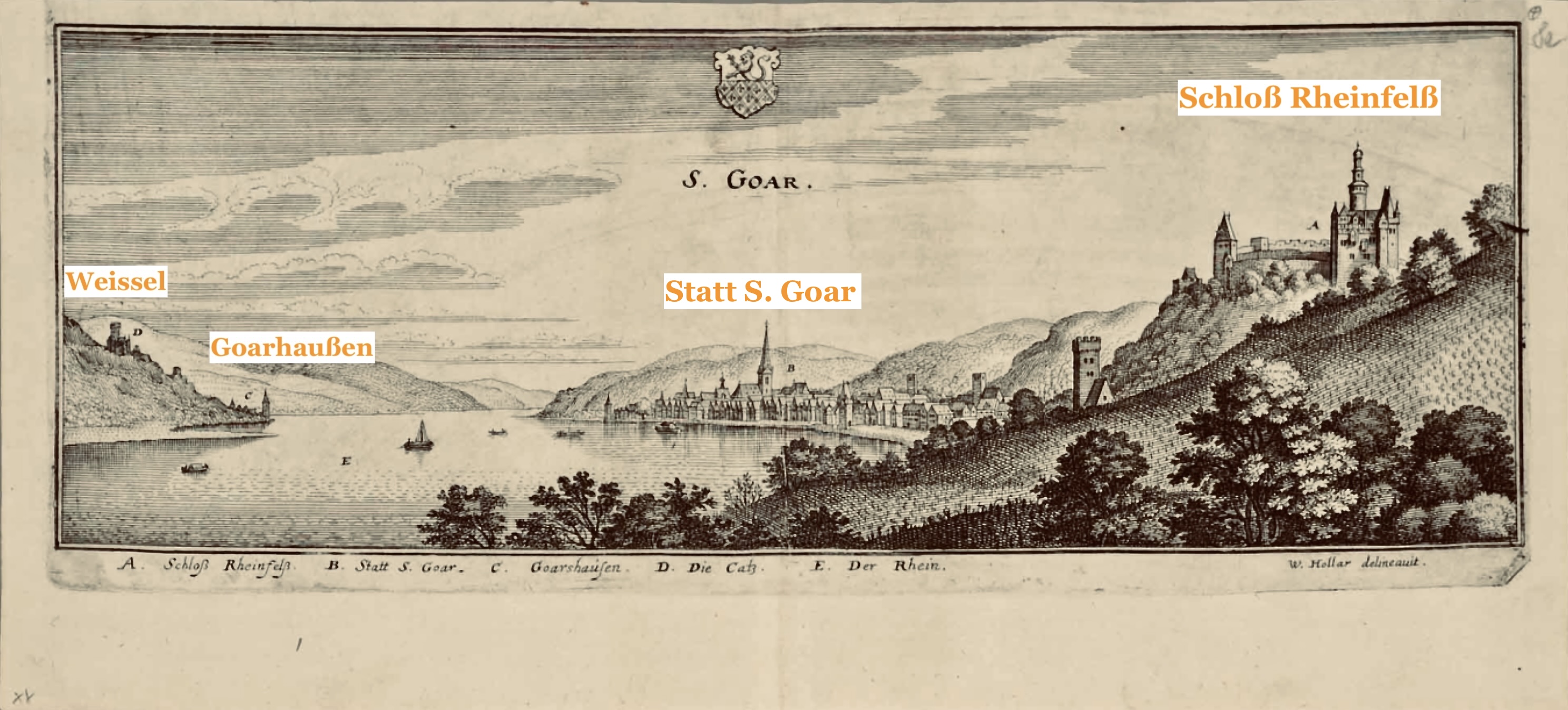
The lid depicts the precise, mountainous stretch of the Rhine Valley surrounding Sankt Goar and Weisel. It is the place Weisel where Johann Jacob Schramm preached, where his parents married in the shadow of the war, the place where the 'first' Johann Daniel rested namelessly in the earth, and the place where he took the ferry across the river to pledge his vows to his Susanne Knopffel.
Every time this harpsichord was played, it opened not just a window to the seventeenth-century artistic tradition of Herman Saftleven and the poetry of Vondel, but an anthology of familial remembrance. Whoever took their seat at this instrument did not merely travel up the Rhine in an armchair – they played the music directly into the landscape of the Dulcken origin, of melancholy, and of love.
III • A Hidden Family Drama and a Love Story on the Rhine
Georg Ludwig Dülcken & Johanna Margareta
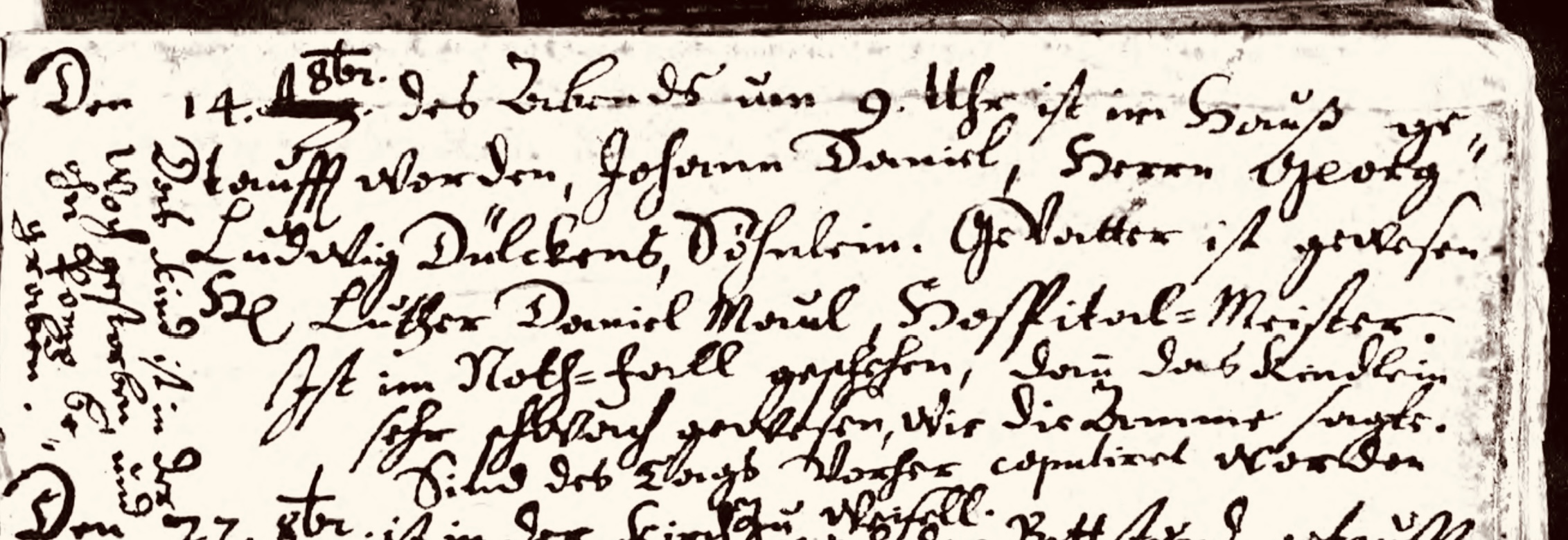
Eine Kopie der Taufurkunde von Johann Daniel, (*) 14. October 1704, Sankt Goar
Thanks to Mrs. Nagel. Moderator Archion Forum
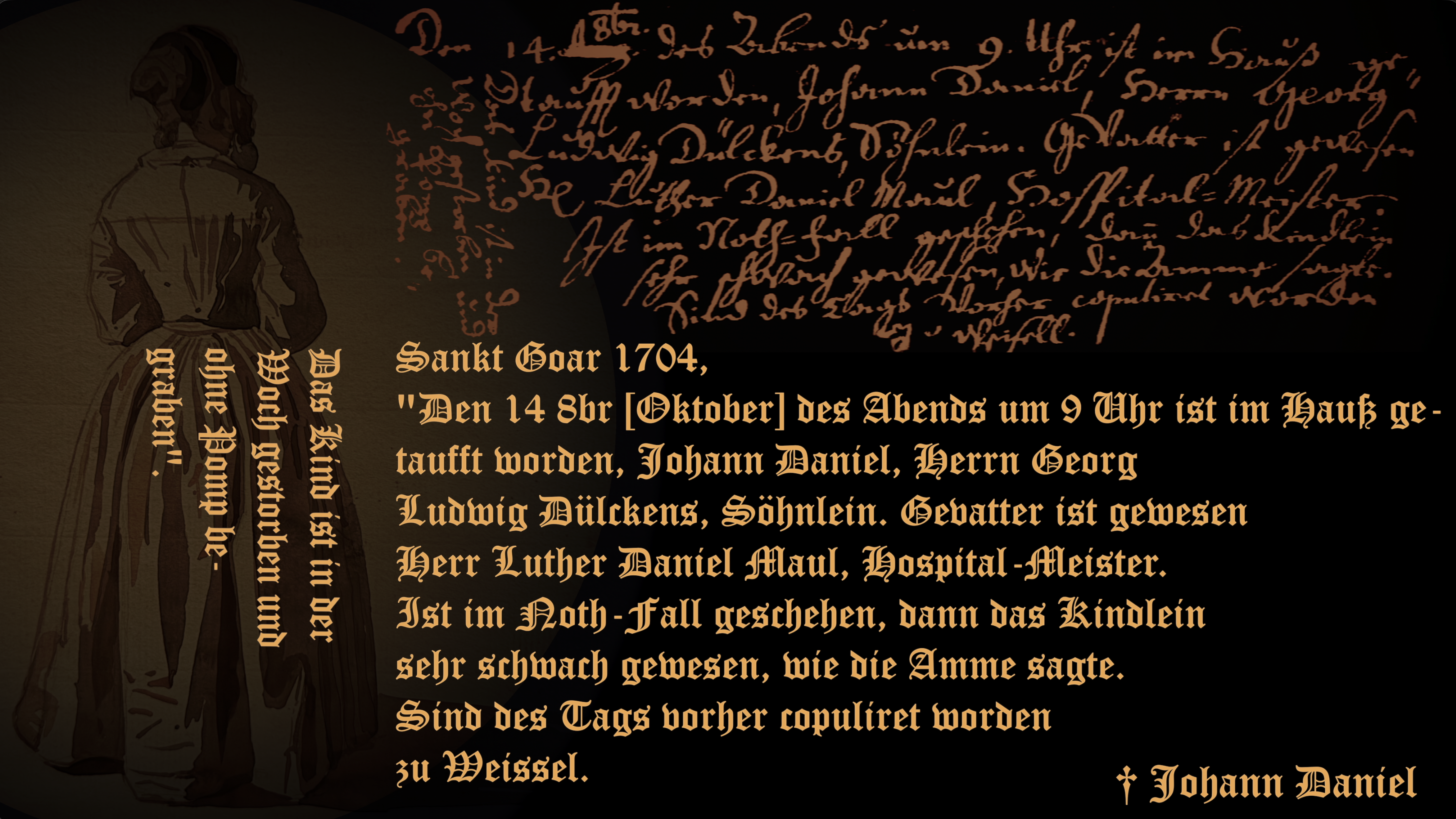
1704,
"On the evening of the 14th of October at 9 o'clock, Johann Daniel, the son of Mr Georg
Ludwig Dülcken, was baptised in the house. The godfather was
Mr Luther Daniel Maul, the hospital master.
This took place in an emergency, as the child
was very weak, as the wet nurse said.
They were married the day before
in Weissel.
The child died within the
week and
was buried without
ceremony".
The Crossing in the Night (Sankt Goar, 1704)
On the evening of October 14, 1704, a deeply moving human drama reached its climax at the foot of Schloss Rheinfels. Georg Ludwig Dülcken, a young theologian from Berleburg, had married his heavily pregnant partner, Johanna Margaretha, in great haste just the day before—on October 13—inside the parsonage of the Rhine village of Weisel. This lightning wedding, performed by his uncle Rev. Johann Jakob Schramm, was intended to avert a bureaucratic and social scandal within the clerical class regarding an out-of-wedlock birth.
Shortly after the ceremony, labor began. On October 14, at around nine o'clock in the evening, their infant son Johann Daniel was born. Because the newborn was extremely weak and his life hung in the balance, a desperate decision was made. While the exhausted mother was unable to leave her confinement bed in Weisel, a perilous night-time crossing of the turbulent Rhine was risked with the critically ill infant. Salvation was sought on the opposite bank, in the larger town of Sankt Goar. There, in the safety of the official residence of the hospital master (Hospitalmeister) Luther Daniel Maul, the dying baby was rushed through an emergency baptism. However, the child did not survive the premature birth and the grueling journey across the water; he passed away within a week and was buried there in total silence, ohne Pomp (without ceremony). Two years later, their next son born in Wingeshausen would be given the exact same name, forever memorializing this lost firstborn.
Johann Daniel Dülcken & Susanna Maria Knöpefell
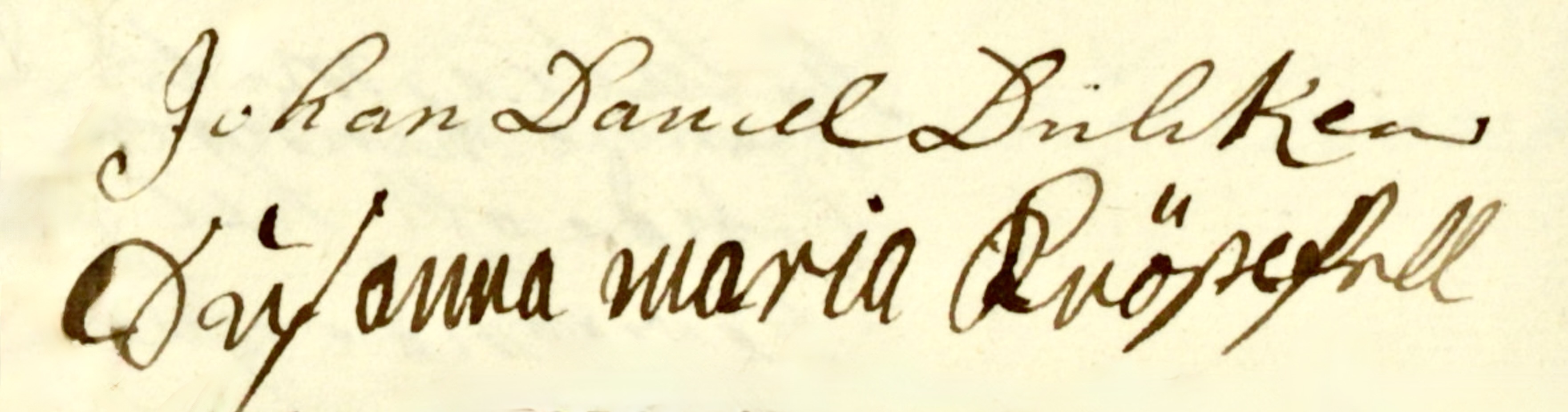

SANKT GOAR - Heiratseintrag 1733 Johann Daniel Dülcken und Susanna Maria Knüpfelin
transcriptie Dr. Johannes Burkardt
Compleet
17. [Decem]ber * Sindt H[er]r Johann Daniel Dülcken, Kauff- u[nd] Handels=mann,
H[errn] Pfarrers Dül=
ckens zu Winches=hausen (sic!) in der Graffschafft Berlenburg
Ehel[icher] Sohn, u[nd] J[ung]fer
Susanna Maria Knüpfelin, des weyland H[errn] Johann Conrad Knüpfels
gewesenen proviant=Com[m]issarii u[nd] Stiffts=Kellers allhie,
nachgelasene Ehel[iche]
Tochter, copuliret u[nd] den 23 t[en] augusti hui[us] anni zum
I stenmal p[ro]clamiret word[en].
* Darunter Eintrag mit blasserer Tinte, aber von gleicher Hand: „16. hui[us] de infra. N[ota] B[ene].“
🇬🇧 Marriage of the merchant and trader Johann Daniel Dülcken, son of the minister Dülcken zu Wingeshausen in the county of Berleburg, with Susanna Maria Knüpfelin, daughter of the deceased Provisions Commissioner and Abbey Waiter Johann Conrad Knüpfel, on December 17, 1733 (For the marriage registration of 1733, it states: Archiv der Evangelischen Kirche im Rheinland, Boppard, KB 149/1 (St. Goar ref.), p. 287.)
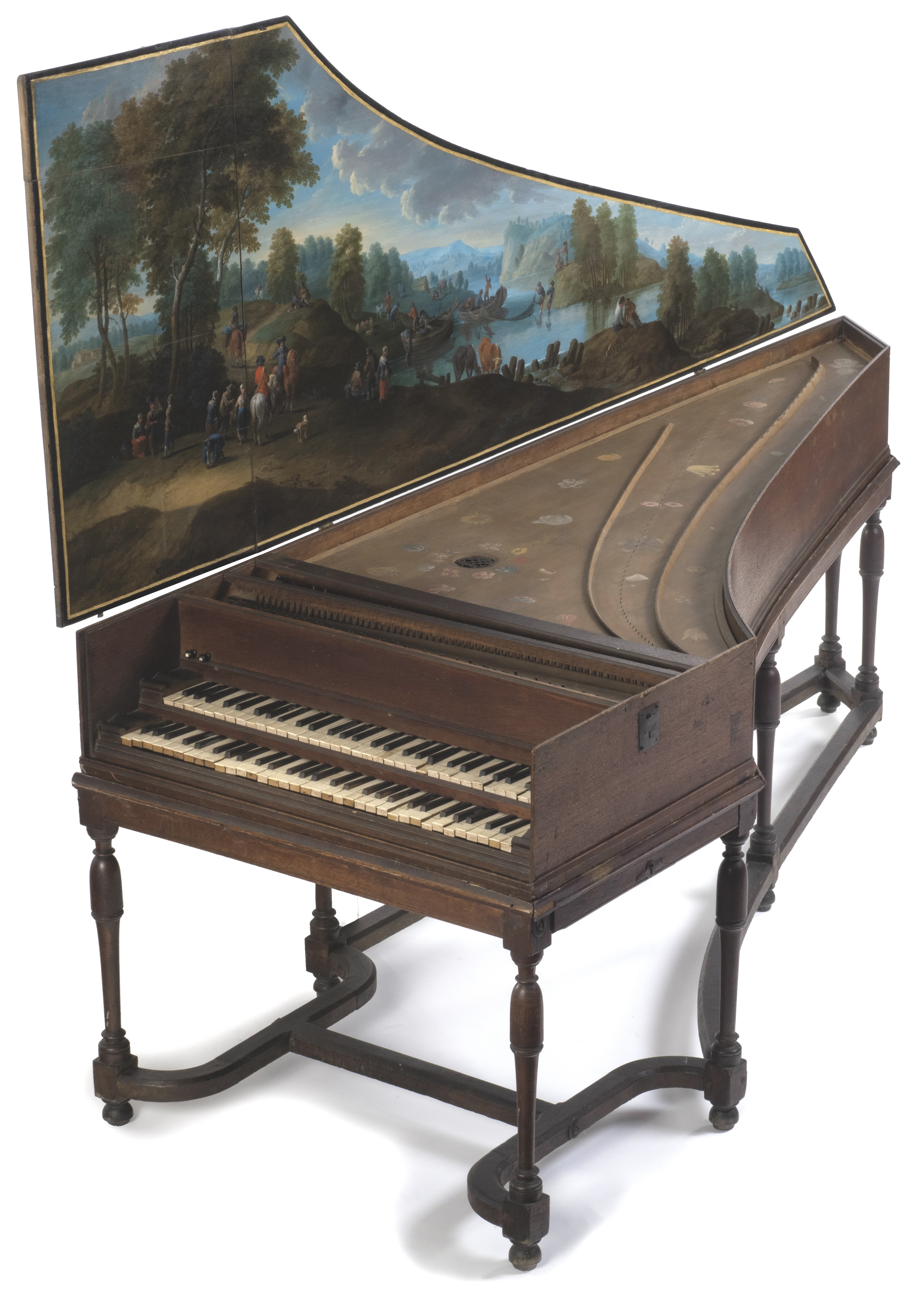
Carolus Bigée: Schilder van syne Conste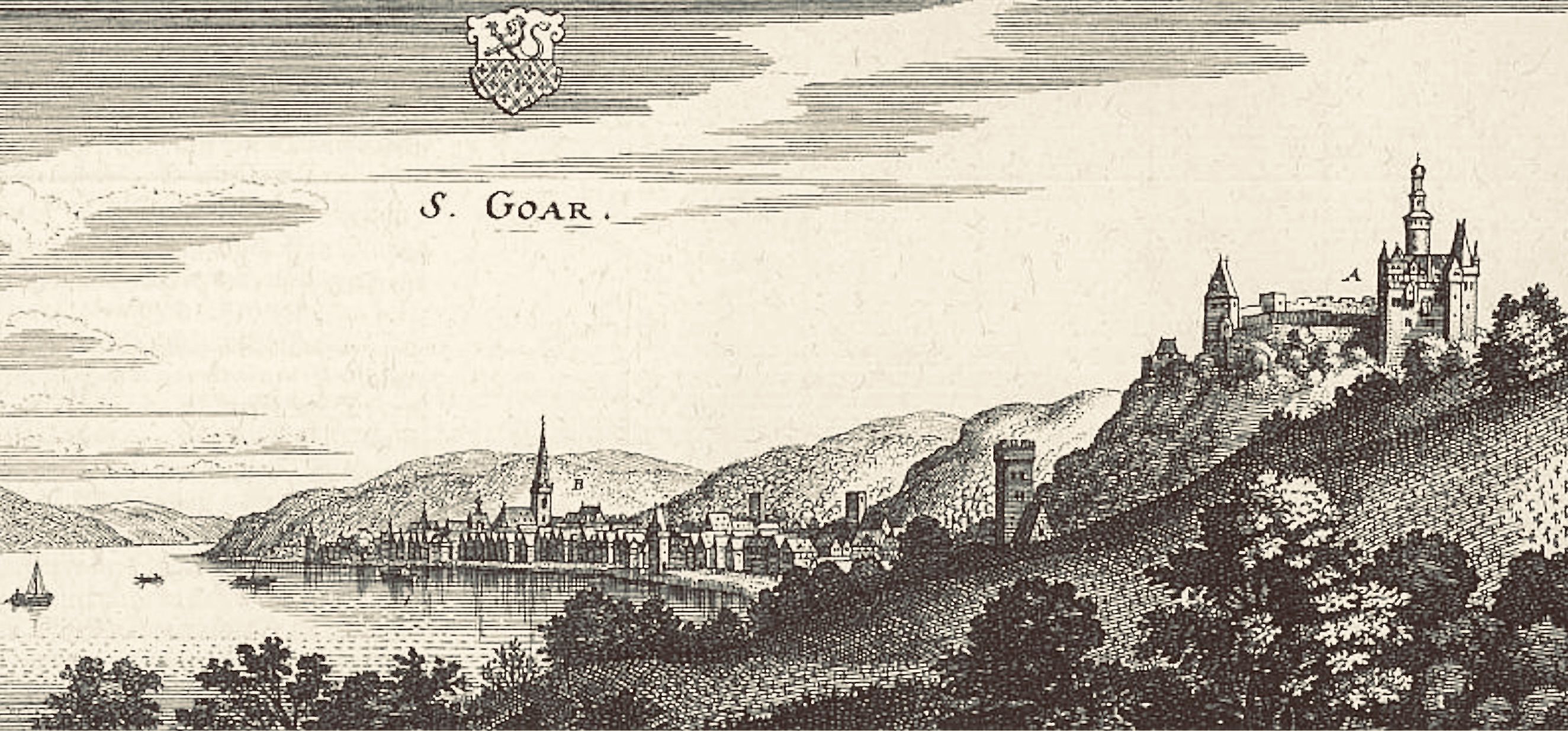
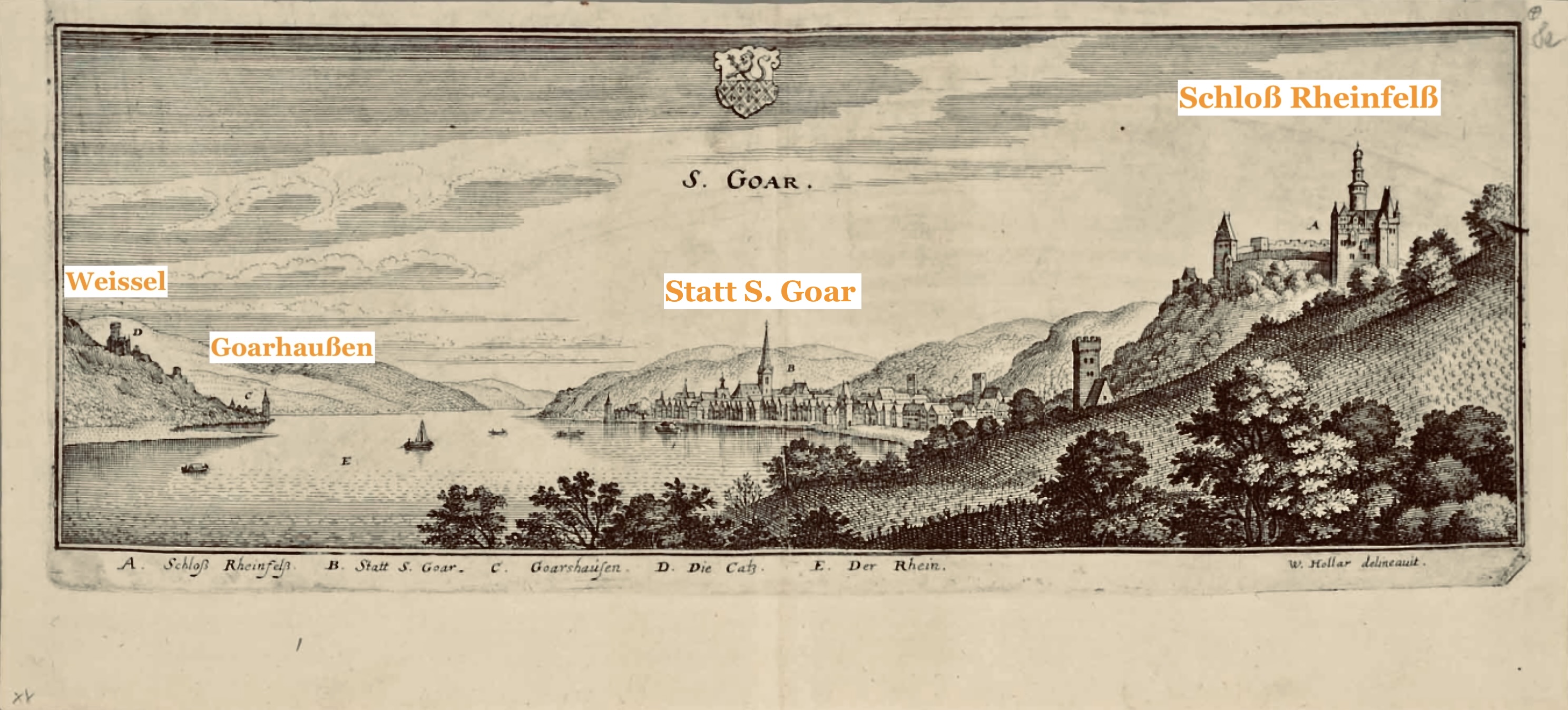
Guide for the Markings on the Print
Rheinfels Castle (Marking: Top right)
This is the colossal castle complex on the hill on the right side of the print, directly marked with the capital letter A.
The Hospitaltor / Hospital Gate (Marking: The small gate by the water)
Look at the row of houses along the waterfront. At the very right edge of the town (just before the open green castle slope begins), you can see the town wall rising from the water.
Exactly where this wall meets the water, there is a small gatehouse with a pointed turret. This is the Hospitaltor.
The Hospital / The "Gotteshaus" (Marking: Directly to the left of the gate)
Directly inside (to the left of) this town wall and right behind the Hospitaltor is the northernmost row of townhouses.
The elongated building with the large hipped roof leaning directly against the town wall (making it the very last large building of the town on the right side, just below the castle slope) is the hospital complex of director Luther Daniel Maul.